

When our brain perceives space differently
Do you recognise that feeling when, during a morning walk, a hill seems much steeper and longer than it actually is? And when you look back on it later, you realise: actually, the path was almost flat. This is not a subjective error – our brains do not always perceive spatial conditions in the way they can be objectively measured.
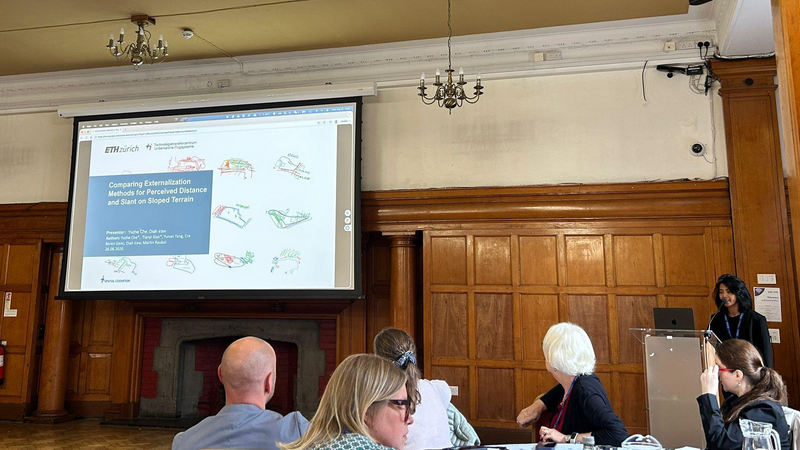
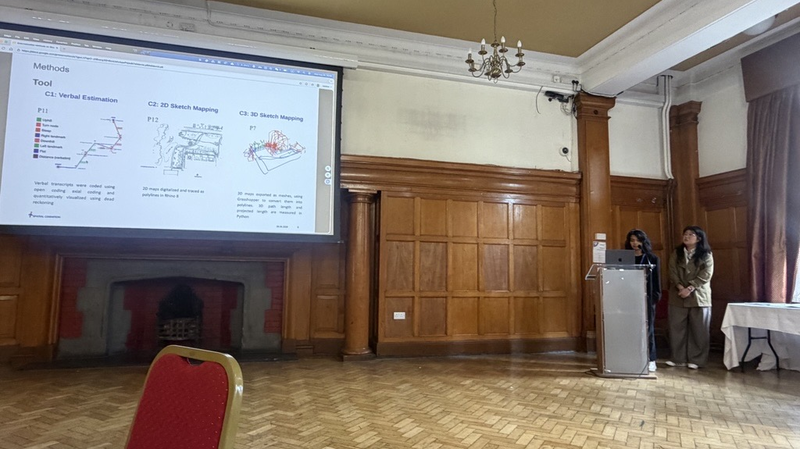
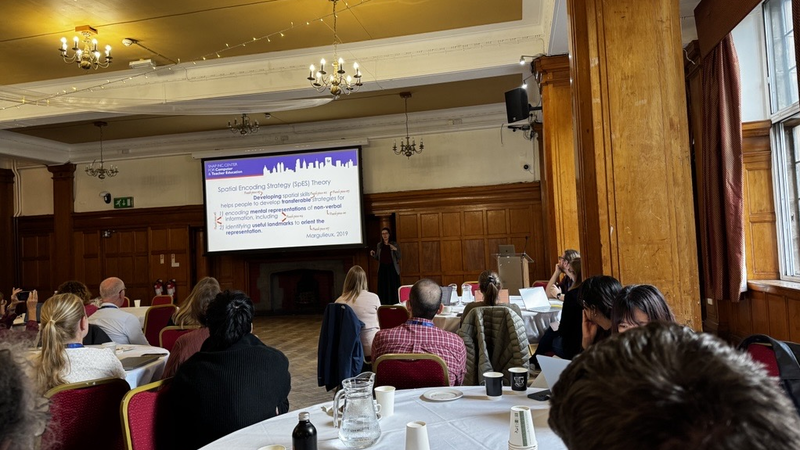
At the “Spatial Cognition 2026” conference hosted by the University of Glasgow, initial ideas for a new research approach emerged during discussions and workshops. Together with her research colleagues and in collaboration with ETH Zurich, Diah Irawati presented her current study there. The study examines an interesting discrepancy between objectively recorded GPS data and actual human perception of spatial distances.
It turns out that people are surprisingly good at remembering the sequence of landmarks along a route. Estimating distances and gradients, however, is considerably more difficult. Our subjective perception of spatial distances and proportions can differ significantly from the actual measured values.
You can find out more about the study in the publication ‘Comparing Externalisation Methods for Perceived Distance and Slant on Sloped Terrain’:
https://doi.org/10.1007/978-3-032-36716-7_6
These findings raise a key question posed by Diah Irawati:
Should intelligent navigation systems continue to rely exclusively on objective, geometric data – or should they also take into account how people actually perceive their spatial environment?
And if the latter is the correct approach: how can individual characteristics of spatial perception be represented in a two-dimensional display of information?
These questions are particularly significant for the development of future intelligent navigation systems. After all, optimal navigation may depend not only on where we are, but also on how we perceive our surroundings.

![[Translate to English:] Logo Akkreditierungsrat: Systemakkreditiert](/fileadmin/_processed_/2/8/csm_AR-Siegel_Systemakkreditierung_bc4ea3377d.webp)