Set-up Phase SAFIR
- Safety for all – Innovative Research Partnership on Global Vehicle and Road Safety Systems
The SAFIR research partnership has linked Ingolstadt University of Applied Sciences with more than 20 partners from industry and public institutions during the set-up phase from 2017 to 2021 to take road safety to a new level. In the process, THI was selected from more than 80 applicants and is thus one of ten universities selected throughout Germany in the funding line "Strong Universities of Applied Sciences - Impulse for the Region (FH-Impuls)". The research program is embedded in the CARISSMA research and test center and will be continued in the intensification phase since 2021.
The overarching social objective of both CARISSMA and SAFIR is to achieve “Vision Zero”
The four principles of “Vision Zero” are:
- Life is non-negotiable.
- Humans are fallible.
- The limits of what is tolerable are determined by human physical capacity.
- People have a right to a safe transport system and a safe working environment.
(Source: German Road Safety Council)
SAFIR-Cluster 1 to 4
SAFIR Cluster 1: Simulation-based test systems for the pre-crash phase
The variety of traffic situations and IVIS/ADAS functions place considerable demands on functional safety and integration tests. The complexity and consequently safety requirements will continue to increase with the introduction ofautomated vehicles and corresponding driving functions. Thus, validation by endurance tests according to today's test standards will become increasingly unlikely in the future. Automated vehicles also need robust fail-safe functions that bring the vehicle into a safe state even under unfavourable conditions and thus prevent accidents. These functions also need to be tested integratively. The focus of IP1 was to develop solutions for solving the problem of system and component validation in the future. For a successful, long-term cooperation with the companies involved, common interfaces for the definition of scenarios/test cases as well as the exchange of data are a basic prerequisite. To achieve these goals, the project developed the "Mixed Reality Test Environment" (MRVU) - an innovative concept for simulation-based driving tests in which the amount between virtual and real tests can be varied for individual dimensions of the test setup in the four dimensions of driver, vehicle, environment and sensor technology. By agreeing on the OpenX standard from ASAM e.V., it became possible to clearly describe data formats for environment representation, driving scenarios, etc. and to carry out data exchange between simulators and real test entities in real time - and thus to comprehensively implement the test environment. The configurations resulting from the application of the MVRU are used to test various aspects of a scenario in a reproducible and non-destructive manner.
The preliminary work in the SAFIR set-up phase now allows new opportunities for research cooperation - even beyond the project duration - and is already being continued in the intensification phase in various projects.
Contact:
Prof. Dr. techn. Priv.-Doz. Andreas Riener
Phone: +49 841 9348-2833
Room: B210
E-Mail: Andreas.Riener@thi.de
Funding reference number: 13FH7I01IA
SAFIR Cluster 2: Test methods for global safety
Cluster II deals with the realization of automated and safe testing on test tracks for vehicle safety 4.0. Due to the high costs of testing, it is necessary to identify few, but "relevant" test scenarios. To this end, a method for evaluating road traffic using drones was developed. With this database, relevant scenarios are identified using machine learning methods, which are then reproduced and varied on a test track for in-depth investigation. The testing procedure requires a highly accurate state estimation of the vehicles. Therefore, a methodology for an improved state estimation with inertial sensors was researched. The special feature of that method is that a highly accurate state estimation can be conducted over longer time spans without correction data. This state estimation is fed into a driving robot, which performs reproducible driving maneuvers. To ensure that highly dynamic driving scenarios with the driving robot can be implemented safely, a method was developed to determine the dynamic limits of the vehicle in different environmental conditions by means of only a few maneuvers on a test site. Both the methods for estimating the vehicle state and for determining the dynamic limits have been incorporated into the products of the project partners. Additionally, in order to specifically address urban traffic, a dummy was developed that simulates a child aged around 6 years. The dummy has movable joints and is operated with artificial muscles so that a natural movement pattern can be imitated.
Contact:
Prof. Dr.-Ing. Michael Botsch
Phone: +49 841 9348-2721
Room: K209
E-Mail: Michael.Botsch@thi.de
Funding reference number: 13FH7I02IA
SAFIR-Cluster 3: Global safety system
The impulse project "Global and cooperative safety system" provides a contribution to the global safety system, starting from integral vehicle safety and making use of digitalisation. To this end, the focus is on innovative subsystems as well as communication per se.
In the case of the subsystems, innovative radar systems for the early detection of pedestrians were considered and successfully prototypically realised in SP 2. Likewise, elements of a so-called pain-sensitive car body for damage detection in carbon-based car bodies were prototypically realised in SP 1. When considering the global safety system, inter-vehicle communication is an essential element. An investigation of the reliability of communication, which is the essential factor in cross-vehicle safety functions, was realised in SP 3 and shown in Figure 4.
To ensure the reliability of communication, components of a real-time capable HIL for Car2X ECUs were investigated in SP 3. A central element here is a simulator for Car2X applications. The open source Car2X simulation environment artery was initially used and its real-time capability validated for 3-5 vehicles [1,2]. Since this number of vehicles massively limits the scenarios to be realised, a new simulation kernel was developed that is real-time capable for approx. 50 vehicles, prototypically realised [3].
[1] Christina Obermaier, Raphael Riebl, Christian Facchi; Limitations of HIL Test Architectures for Car2X Communication Devices and Applications; 3rd ACM Computer Science in Cars Symposium (CSCS); 2019
[2] Christina Obermaier, Raphael Riebl, Ali H. Al-Bayatti, Sarmadullah Khan, Christian Facchi; Measuring the Realtime Capability of Parallel-Discrete-Event-Simulations; MIDP electronics Special Issue "Communication Technologies for VANETs"; doi: 10.3390/electronics10060636; 2021
[3] Christina Obermaier, Raphael Riebl, Ali H. Al-Bayatti, Sarmadullah Khan, Christian Facchi; COSIDIA: An Approach for Real-Time Parallel Discrete Event Simulations Tailored for Wireless Networks; ACM SIGSIM Conference on Principles of Advanced Discrete Simulation (PADS) 2021 (accepted paper)
Contact:
Prof. Dr. rer. nat. Christian Facchi
Phone: +49 841 9348-3650
Room: P001
E-Mail: Christian.Facchi@thi.de
Funding reference number: 13FH7I03IA
SAFIR-Cluster 4: Safe electric mobilty
As part of SAFIR IP4, a worldwide survey was carried out as part of a publication for the European Association for Accident Research and Analysis (Europäische Vereinigung für Unfallforschung und Unfallanalyse e.V.) and involving over 200 accident analysts, most of whom work for courts. The results of this survey showed that the influences of driver assistance systems (DAS) and automated driving functions (AF) on the course of an accident can so far only be clarified beyond doubt in rare cases. This has an enormous impact on both legal certainty and victim protection. In order to be able to reliably clarify the influences of FAS and AF forensically in the future, several investigations were carried out and methods developed within the framework of SAFIR IP4.
A central element was the implementation of tests to determine the possible influences of FAS and AF on the vehicle's driving dynamics and the driver's behaviour. The results from the empirical tests flow into a database as scientifically sound basic data that can be used as a reference for forensically active accident analysts in their court reports.
At the same time, the tests showed that the system behaviour during an accident often diverges greatly. Digital traces are indispensable in order to be able to accurately depict the actual course of events for forensic purposes. Accordingly, solutions were developed for extracting accident-relevant data from vehicle control units using reverse engineering methods. In the future, however, all required data elements should be stored in a Forensic Event Data Recorder (FEDR), which was designed within the framework of the project.
The THI has acquired a special role throughout Germany for the forensic clarification of the influences of FAS and AF, in particular through intensive exchange with the police, experts, monitoring organisations, universities, insurance companies and the ADAC as well as through publications and committed participation in conferences and panel discussions.
Contact:
Prof. Dr. rer. nat. Hans-Georg Schweiger
Phone: +49 841 9348-4500
Room: H026
E-Mail: Hans-Georg.Schweiger@thi.de
Funding reference number: 13FH7I04IA
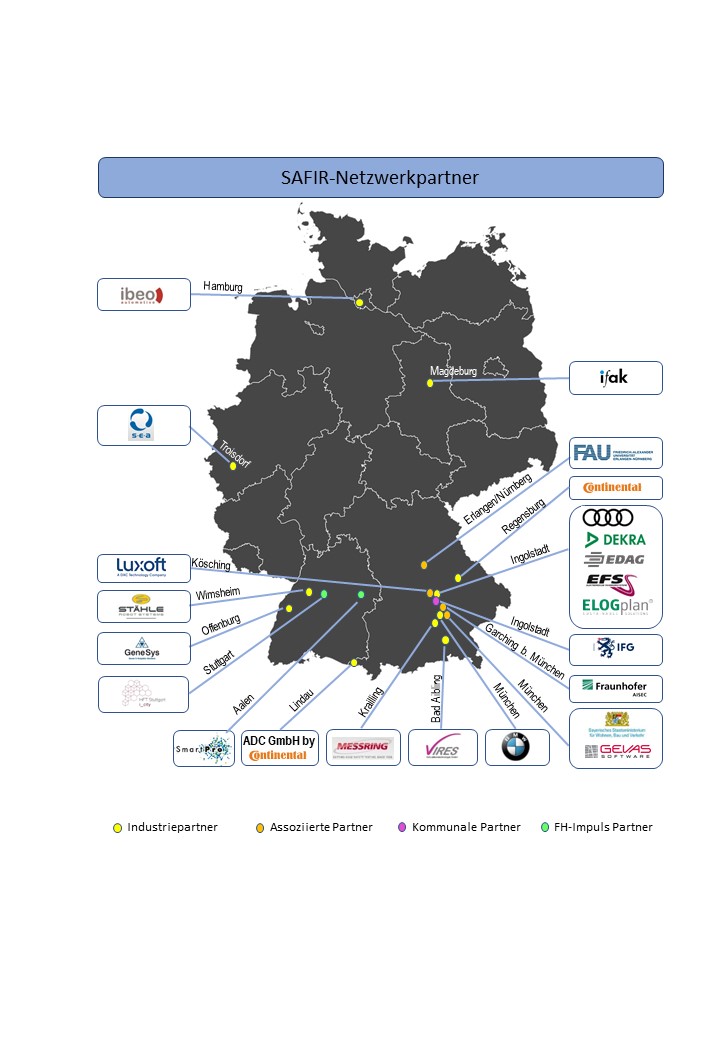
Partner Network in Set-up Phase
The center of the SAFIR network partnership was and is the THI, with the CARISSMA research building, as a research-strong HAW with proven expertise in the HRK research focus on vehicle and traffic safety, as well as specialized SMEs and suppliers in the environment of vehicle safety. The SAFIR innovation partnership comprised 22 partners in the start-up phase and focused on close networking between industry and science in research and development topics. The IFG Ingolstadt, as a company of the city of Ingolstadt for location and business development, accompanied SAFIR as a municipal project partner in the field of autonomous mobility in urban areas.