
Higher education organisation

A welcome message from the President, Prof. Dr Walter Schober
Dear visitors to our website,
I would like to extend a warm welcome to you to the website of Ingolstadt University of Technology. With 900 staff members, we support over 8,600 students across more than 75 Bachelor’s and Master’s degree programmes in engineering and economics. 220 professors across six faculties, eight research institutes, 160 international partner universities and a modern administrative structure – these are further key figures for our university. But what lies behind these figures? It is quality in practice-oriented teaching, innovative strength in applied research and a campus with an attractive environment, at the heart of which we place our students.
A key feature of studying at our university is its practical relevance. We train students to become specialists and managers who are in demand in the labour market. A dynamic and successful region with a strong economic structure provides the ideal conditions for this. Work placements and project work in collaboration with regional companies are central components of every degree programme. In addition, our university is characterised by its close-knit atmosphere. In this way, we ensure the success of a highly qualified education through individual support. And we offer our students a career path from a Bachelor’s degree through to a Master’s and a PhD at one of our research institutes. Over 175 doctoral candidates are following this path.
We offer companies various forms of collaboration: we welcome partners not only for dual study programmes but also provide a wide range of part-time academic further education courses. Opportunities for collaboration also arise in the field of research. Here, we hold a leading position amongst universities of applied sciences nationwide. With more than 70 research-active professors and over 300 research assistants, we cover a wide range of research fields. With the CARISSMA research building, we form the national scientific centre of excellence for vehicle safety. And as a Bavarian AI mobility hub, we are establishing a centre for Artificial Intelligence with around 120 research staff, supported by the Bavarian High-Tech Agenda. Through our innovations, we are securing Bavaria’s position as a centre of science and business. And we are living up to our vision: Talented individuals and innovations – for a future worth living.
I hope you enjoy browsing our website and invite you to visit us on our social media channels too.
I would, of course, be particularly delighted to welcome you in person to the campus of the Technical University in Ingolstadt or to the new Neuburg campus, with its range of degree programmes in the fields of energy, the environment and construction.
Yours sincerely
Prof. Dr Walter Schober
President
University bodies
The central governing bodies of the THI are the University Council, the Senate, the University Management and the Extended University Management. Together, they form the governing and supervisory body for the entire institution.
The Research Council is responsible for coordinating research at THI.
In the area of teaching, THI is organised into six faculties: Mechanical Engineering, Electrical Engineering and Information Technology, Computer Science, Industrial Engineering, the Business School and Sustainable Infrastructure. Internal faculty matters are governed by the respective Faculty Council. Academic continuing education is based at the ‘THI Campus for Continuing Education (TCW)’ faculty.

Faculties
Bavarian Higher Education Act
The basic functions and bodies, together with their areas of responsibility and decision-making powers, are laid down in the Bavarian Higher Education Act (BayHSchG).
Constitution of the THI
The provisions accompanying the BayHSchG are set out in the THI’s Constitution.
The support units and service departments provide cross-faculty and cross-institutional support with administration and organisation. The special representatives appointed by the university management coordinate the relevant areas across the university.
Support departments
Service units
Special functions
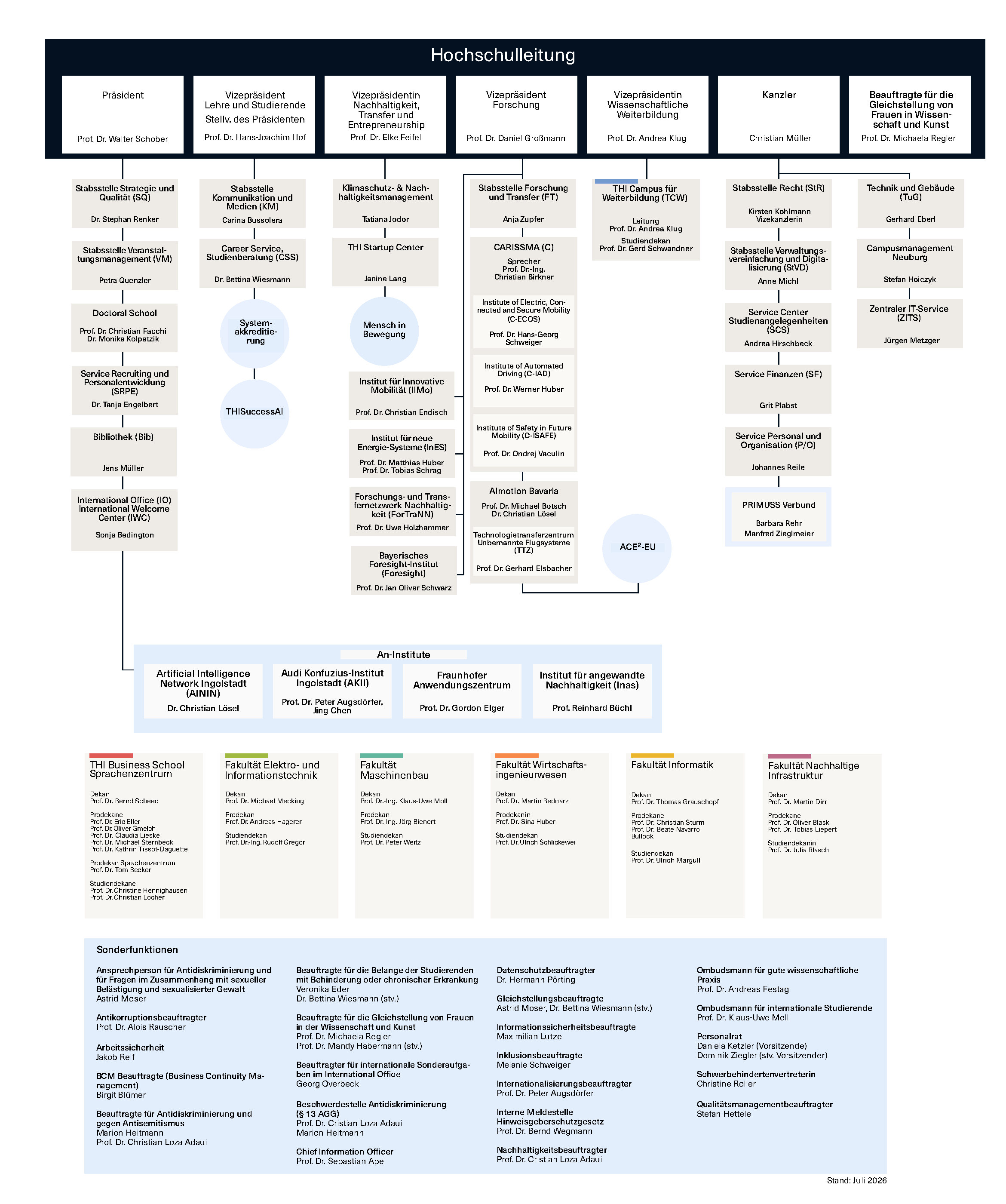
Organisation chart
The THI organisational chart provides a concise overview of the organisational structure and areas of responsibility.