Quality management in study programmes and teaching
THI has held system accreditation since October 2022 and is therefore authorised to carry out the accreditation procedures for its degree programmes itself.
High standards of quality in study programmes and teaching are a matter of course at THI. Through integrated quality tools, which are already embedded in the design of the degree programmes, THI ensures that the programmes offer highly application-oriented and practical content to provide students with the best possible education.
The quality management system for study programmes and teaching has undergone continuous development at THI.

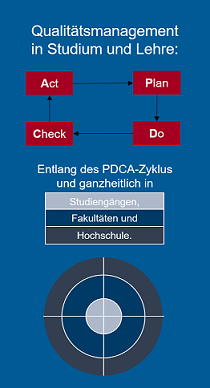
Understanding of quality management
The Plan-Do-Check-Act cycle forms the basis of the university-wide quality management system. The quality management system operates systematically throughout this cycle at university, faculty and degree programme levels. Tools for quality planning, assurance and review are embedded at all levels. External experts are regularly involved through subject advisory boards. In addition, each faculty has implemented its own subject- and culture-specific quality assurance tools (e.g. programme directors’ meetings, QM workshops, round-table discussions, etc.). Internal accreditation procedures assess, at degree programme level, whether the quality standards for study and teaching are being met.
Accreditations
As a state university, THI is obliged to demonstrate that its degree programmes are regularly accredited. Accreditation procedures assess whether degree programmes meet the statutory quality requirements. Degree programmes that have successfully completed the process are awarded the ‘accredited’ seal by the German Accreditation Council.
All established THI degree programmes have received the ‘accredited’ seal of approval or are currently in the final stages of the process. The accreditation status of a degree programme is published in the German Accreditation Council’s ‘ELIAS’ database of accredited degree programmes. An overview at degree programme level can be found here.
The Vice-President for Teaching is responsible for the quality of teaching at THI. The Quality Management Officer is responsible for the operational coordination of accreditation procedures at THI. Within the (academic) faculties, the respective Deans of Studies are responsible for coordinating the procedures.
THI distinguishes between INITIAL accreditation of new degree programmes, RE-accreditation of existing degree programmes and the accreditation of a substantial change. The accreditation procedures verify whether the formal and subject-specific criteria set out in the Bavarian Study Programme Accreditation Ordinance (BayStudAkkV) are met. To this end, following the submission of the application and a check by the Vice-President for Teaching to ensure the documents are complete, the Accreditation Commission – comprising five academic staff members, one student and one research assistant – is convened to carry out the assessment and appointment of external subject-matter experts for the subject advisory board. The formal criteria are assessed by the Quality Management Officer. The subject advisory boards (university lecturers, representatives from professional practice, and representatives of external students) carry out an assessment of all subject-specific criteria and, where necessary, issue recommendations for the further development of the degree programmes. The subject advisory boards’ assessment is forwarded as a draft resolution to the Accreditation Commission, which may only deviate from the subject advisory boards’ assessment if it provides justification for doing so. The Accreditation Commission makes the final accreditation decision on the basis of the subject advisory board’s assessment (accredited – not accredited, with or without conditions – recommendations). The President then, in agreement with the decision of the Accreditation Commission, grants or rejects the accreditation.
The entire accreditation process is illustrated in the diagram below:

Evaluations and surveys
Student feedback on studies and teaching at THI is systematically collected through various survey methods. The aim is to foster a constructive dialogue between students and teaching staff based on the relevant data, so that targeted measures can be devised and implemented. Throughout their entire course of study, students are asked to provide feedback on their studies and teaching at THI.
The procedures and responsibilities are set out in THI’s Quality Management Regulations. All evaluations take place exclusively online. To ensure compliance with legal requirements, all evaluations and surveys are reviewed for data protection compliance.
At THI, the following evaluations are carried out regularly as part of the quality assurance process.
Results
The survey results are discussed with students, within the faculties and in the university’s academic bodies. Students can find out about the key findings in the ‘Quality Management’ Moodle course room. Key findings are also published here on the website.
Teaching reports
The Deans of Studies from all faculties draw up an annual teaching report in which they assess the state of teaching and the organisation of degree programmes. The aim is to ensure the quality of teaching and study at THI, to identify areas for improvement, and to further develop teaching and study. The data for the teaching report is provided by the central Strategy and Quality Unit.

Advisory Boards
The Academic Advisory Boards were established in the winter semester 2020/21 to provide a formal framework for the involvement of external experts from academia and professional practice in the (further) development of degree programmes in accordance with Section 18(1) of the MRVO.
The subject advisory boards are appointed by the Accreditation Commission following an application for accreditation and on the recommendation of the faculty councils. The role of the subject advisory board is to review and assess the subject-specific and content-related criteria in accordance with the BayStudAkkV. The subject advisory board may, amongst other things, propose reforms to degree programmes, adjustments to lecture content, alternative programme structures or new specialisations. The subject advisory board’s assessment and recommendations are subsequently considered as a draft resolution by the Accreditation Commission. The final decision regarding accreditation is also adopted there. The Accreditation Commission may only deviate from the subject advisory boards’ assessment if it provides justification for doing so.
The following groups are represented on the Academic Advisory Board: at least two external university lecturers, a representative from the professional sector, and a student from a related degree programme at another higher education institution.
The Quality Management Officer is responsible for coordinating the meetings of the Subject Advisory Board. In advance, the members of the Subject Advisory Board receive all accreditation-related documents for the degree programme, as well as training materials for assessing the subject-specific and content-related criteria in accordance with the Bavarian Study Programme Accreditation Ordinance (BayStudAkkV).
The university has drawn up a set of regulations governing the work of the Academic Advisory Board, which will come into force on 1 January 2023.
Contact
Stefan Hettele
Quality Management Officer

Stefanie Probst
Quality and knowledge management consultant

Links
TCW Quality Management System

Further information
Successful accreditation processes
Accreditation status of degree programmes
Information on the German accreditation system:
German Accreditation Council
AACSB accreditation of the Business School
The faculty has been AACSB-accredited since 2024. Only around six per cent of all business schools worldwide achieve this. In Bavaria, THI is therefore the first university of applied sciences to have successfully completed the accreditation process. About AACSB; about THI@AACSB.
Are you interested in serving on the advisory board, or have you been approached about it? Do have a look at our information leaflet.
In preparation for the examination and assessment of the subject-specific criteria (BayStudAkkV), training materials have been produced for the members of the advisory boards; these can be accessed via the link below:
