Prof. Dr.-Ing. Christian Endisch
Head of the Institute for Innovative Mobility (IIMo), Programme director and Academic advisor "Applied Reserach in Engineering Sciences" (Master)


Master of Science (M. Sc.)
The Research Master’s programme offers you the opportunity to develop and carry out your own research project throughout your studies. Through close collaboration within research groups, access to state-of-the-art laboratories and personalised supervision, you will gain valuable practical experience in research and development. This will equip you with the best possible foundation for challenging roles in industry or an academic career.
The Master’s in Applied Research in Engineering Sciences is deliberately designed to differ from traditional Master’s programmes. Rather than an extensive programme of lectures, the focus is on a student’s own research project, which spans the entire duration of the programme. This provides ample scope to apply scientific methods directly to real-world research and development projects and to specialise in one of ten future-oriented fields.
As early as the first semester, students systematically familiarise themselves with their research topic and, through literature reviews and scientific analysis, lay the foundations for their subsequent work. The second semester involves practical implementation, for example by setting up a test bench, developing new algorithms or carrying out measurement series. These results form the basis for the Master’s thesis in the third semester. As all three pieces of work build on one another, students do not start their final thesis from scratch but already possess a deep understanding of their research topic. From the outset, students are integrated into a research group, make use of modern laboratory facilities and receive personalised support from a professor and a mentor. This personalised support programme ensures rapid professional and personal development and provides the ideal preparation for taking on roles of responsibility in research and development or for going on to do a PhD.
Online Master-Talk Nov. 18 2026, 2:30 p.m.
The core of the program is project work: in the first and second semesters, you will work on two consecutive projects that will ultimately lead to your master's thesis in the third semester. From the very beginning, you will be part of a research group with access to modern laboratory infrastructure, current topics, and real research work.
You will benefit from personal support on several levels: from a mentor (usually a doctoral student), a supervising professor, the program director, and an accompanying scientific seminar for exchange with other students.
Depending on your project work, you will choose one of ten subject areas, which will set the thematic framework for your studies and will later be listed on your transcript. Each subject area has four fixed compulsory modules. This ensures that theory and practice are closely linked in terms of content.
Here are the ten areas to choose from. To view the compulsory modules, please click on the relevant area:
This close integration gives you in-depth, application-oriented knowledge. You specialize in a specific area that is highly relevant to your professional development. In addition to these four fixed modules corresponding to your field of study, you can choose two further interdisciplinary modules. These freely selectable modules can also include inter-university modules.
A key feature of this program is the personal support you receive. You benefit from well-thought-out, multi-level support:
This structure ensures continuous exchange, orientation, and reliability as a basis for your academic success and beyond.
You will work directly in the laboratories of active research groups. This means you will benefit from first-class laboratory equipment, high-quality analysis and development tools, and have access to resources that are not available in traditional degree programs. You will use equipment and technologies that will prepare you optimally for your future career, whether in development, pre-development, or research. There is often the opportunity to be employed as a research assistant within the project. This not only allows you to gain valuable practical experience, but also secures you an attractive financial foundation.
Applied Research in Engineering Sciences leads to the Master of Science (M.Sc.) degree, which is typical at universities. This internationally recognized title underscores the high academic standards of the program and opens up a wide range of career opportunities, both in demanding technical and managerial positions in industry, for example in pre-development or project management, and as a solid foundation for a subsequent doctorate.
The close integration of theory and practice gives you in-depth insights into innovative technologies and development processes. This provides you with the ideal conditions for entering the industry directly, for example in areas with a high level of responsibility and technically demanding tasks. At the same time, the program also provides an excellent foundation if you decide to pursue an academic career.
Real guidance for career planning: Through close involvement in a research group and collaboration with a mentor (usually a doctoral student themselves), you will gain realistic insights into everyday research. This will give you a solid idea early on whether a doctorate is the right next step for you. After three semesters, you will be able to make a clear decision about which career path you want to pursue! This is a major advantage that a traditional master's program does not usually offer.
The research master's program deliberately focuses on quality rather than quantity in order to guarantee you optimal support and a high-quality infrastructure. Admission is based on an aptitude assessment procedure that tests your qualifications and motivation.
Experience shows that those who are accepted not only meet the requirements, but also benefit from a system that is consistently geared toward individual success.
The results speak for themselves: Research Master's students do not start from scratch. From the outset, they are integrated into established research groups and receive continuous support from experienced mentors. The close integration of theory and practice, combined with individual supervision and excellent support, ensures a steep learning curve and measurable success. The degrees awarded in previous years are consistently above average. This is no coincidence: those who pass the aptitude test have the necessary potential and consistently develop it further in the research master's program. The structured framework of the program reliably leads to the goal and creates the conditions for individual academic development at a high level.
Room for individual paths: The research master's program opens up space for individual study paths, for example by incorporating a semester abroad or an international research stay. Such projects can be integrated flexibly and precisely into the program. Mentors, supervising professors, and program directors are available to provide advice and contribute their experience in implementing individual plans.
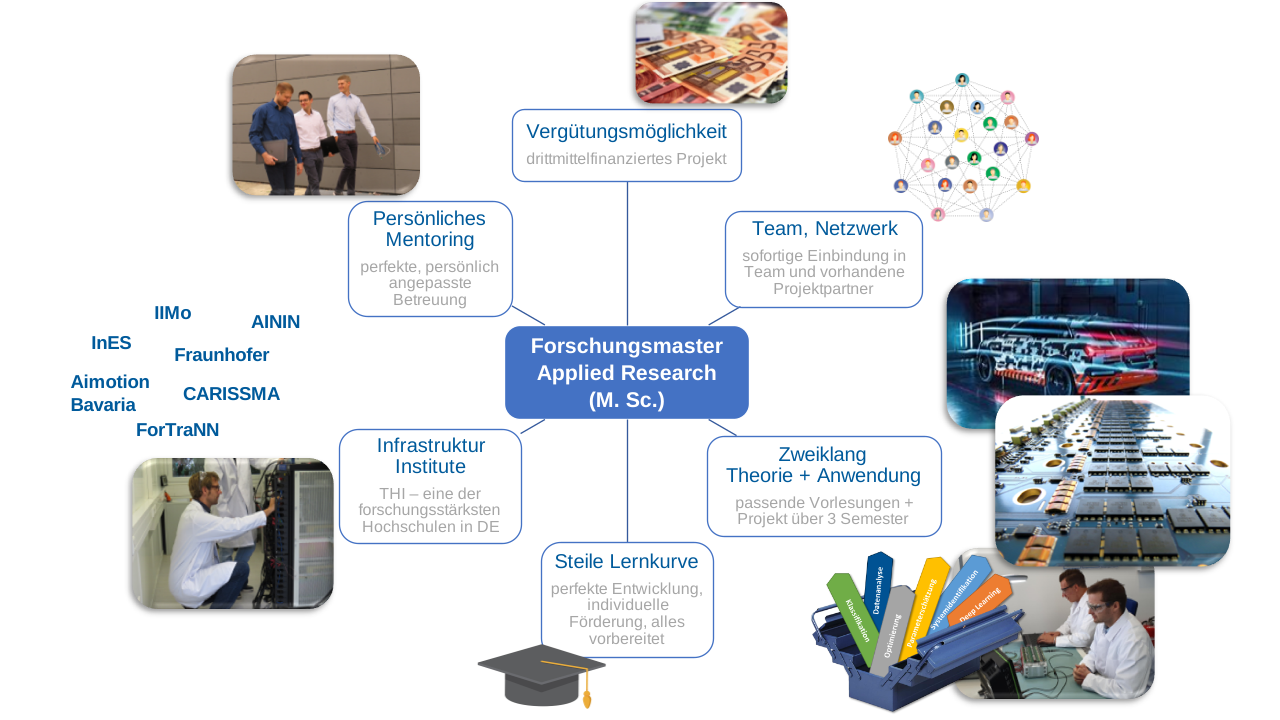
The Master's in Applied Research in Engineering Sciences is not a run-of-the-mill degree program. It is more of an individual development program, with real project work, personal support, and a clear structure, on the path to your successful professional future.
As with other degree programs, applications for the research master's program are initially submitted via the Technical University of Ingolstadt's applicant portal.
At the time of application, you do not need to have a specific research topic or a supervising professor. Assignment to a department and a supervisory team takes place as part of the application and aptitude assessment process.
Here's an overview of the process:
Once the SCS has checked that you meet the formal admission requirements, your application will be forwarded to the program director. In an initial contact, the program director will clarify key questions, such as your academic interests, possible topics, or your desire to work as a research assistant.
The second step is the preliminary assignment to a department and a potential research group. Your interests are taken into account, as are the capacities and thematic focuses of the professors involved.
In a third step, you will meet the proposed supervising professor and mentor in a personal interview. This will allow you to assess whether the supervisory environment meets your expectations. If no suitable match can be found, the program director will provide support and the steps described above will be repeated until a suitable environment is found.
Even though this process involves a certain amount of effort, personal supervision, structured project work, and individual support are central components of the research master's model and thus prerequisites for success. A harmonious professional and personal assignment is crucial for students to develop in the best possible way in the research environment. The procedure described here ultimately not only increases the quality of supervision, but also ensures that external applicants have fair and equal opportunities for seamless integration into the program.
Once you have found a suitable environment for your research master's program, the program director will inform you of the topic of your presentation for the selection interview. You can read about the next steps under the heading “Aptitude assessment.”
Qualification requirements
Admission to the research master's program requires an above-average bachelor's degree in a relevant field of study in accordance with the study and examination regulations, as well as successful participation in the aptitude assessment procedure.
Aptitude assessment
As part of the program-specific aptitude assessment, you will be assigned a presentation topic by the program director. The selection interview lasts a total of 30 minutes and consists of a presentation prepared by you, followed by a technical discussion. The aim of the interview is to determine your suitability for the program in accordance with the study and examination regulations (SPO). The supervising professor is usually a member of the selection committee. The evaluation of the selection interview is included in the aptitude assessment together with the bachelor's degree grade. With the minutes of the selection committee, the department of your research master's program is finally determined and communicated to the SCS.
In the Applied Research master's program, you have the opportunity to be remunerated for your work on third-party-funded research projects—an attractive unique selling point of this research-oriented program.
Specifically, you will take on project-related tasks such as performing data analyses, assisting in the construction of test benches, conducting literature research, providing support with programming tasks, setting up measurement technology, performing and evaluating measurement series, and subsequently documenting the results. Although these activities must be formally separated from the graded research projects, their content can often be meaningfully linked to your project or master's thesis. This creates practical synergies that strengthen both your research work and your qualifications.
Employment as a research assistant is voluntary and depends on the financial resources of the supervising professor and the respective research group.
Such a paid position not only offers you financial support during your studies, but also valuable practical experience and a clear advantage for your resume.
Note: Due to the current sharp reduction in research funding and budgetary uncertainty under the new government, financing is currently only possible in rare cases. We hope that the situation will improve again soon.
Appropriate scientific conditions must be ensured for the individual scientific development of research master's students at a high level. Professors from THI therefore participate in the research master's program, who can guarantee scientifically sound supervision through their active research.
The supervising professor, together with his or her research group and the available laboratory infrastructure, provides the necessary conditions for the successful completion of the individual research project. Thematically, his or her research activity must correspond to the chosen subject area of the research master's program.
In the research master's program, each student is accompanied by a mentor. The mentor is a member of the supervising research group and is usually a doctoral candidate themselves. They are available as a constant point of contact in everyday work and provide support in the practical implementation of the research project as well as in methodological and organizational questions. The collaboration takes place directly in the project context and enables close professional support throughout the entire duration of the program.
In addition, the mentor also helps with organizational questions regarding the course of study, such as planning modules, deadlines, or coordination with the supervising professor.
The supervising professor is responsible for the overall academic supervision and evaluation of the project and master's thesis. The mentor and professor usually work in close coordination, but have clearly defined roles in the supervision process.
The Examination Board is a central committee of the Research Master's Program and plays a key role in ensuring quality and compliance with the study and examination regulations. It is responsible for both examination-related decisions and the further development of the program's curriculum.
One of the examination board's main tasks is to oversee the aptitude assessment procedure. It selects the reviewers from among the professors who will conduct the procedure for the respective applicant. The board determines the criteria and the procedure and, in cases of doubt, makes the final decision on aptitude.
The committee also plays a central role in examination matters. It approves the topics of the two project theses and the master's thesis and decides on applications for deadline extensions, recognition of external academic achievements, or special study programs. Students in the research master's program can also take a limited number of modules from other universities (so-called HÜ modules). In these cases, the examination committee reviews and approves the creditability and suitability of the modules in relation to the overall curriculum.
In addition, the examination board is responsible for the curricular structure of the program. It decides on the establishment, restructuring, or dissolution of departments. There are currently ten departments, which are thematically aligned with the program's research areas. The number and content focus of these areas may evolve over time. For each department, the board approves the four corresponding compulsory modules proposed by the program director.
In addition to its curricular responsibilities, the examination board also contributes to quality assurance in terms of supervision. It reviews and approves the supervising professors in the program, particularly with regard to their research activities, project experience, and thematic fit. In this way, it ensures that the academic framework for the project work and the master's thesis meets the requirements of the research-oriented program.
Overall, the examination board plays a key role in the research master's program: it not only ensures that the program is run properly, but also actively participates in the further development and quality assurance of the program, both structurally and in terms of content. The examination board of the research master's program at THI is composed of the following members: Endisch (chair of the examination board), Facchi, Gaull.
At the beginning of your studies, you choose one of the 10 subject areas. In accordance with the SPO, the subject-specific elective modules that apply to you are treated as “compulsory modules.” Once the selection committee has made its final decision (as part of the aptitude assessment), it is no longer possible to change the compulsory modules that apply to you (or your subject area). The subject area you have chosen will ultimately be listed on your degree certificate.
You have a wider range of choices when it comes to the interdisciplinary elective modules, which the program director also likes to refer to as “elective modules.” The program director creates the offering and documents it in the module handbook. In addition, in accordance with the SPO and cooperation agreement, you may also include the HÜ modules from THI and other cooperating universities. HÜ modules must be selected before the start of the semester. No prior official registration is required for all other interdisciplinary elective modules. You only need to register for the corresponding exam. However, in order to be able to create the exam schedule, please inform us of your choice as soon as possible via the program's functional address apr@thi.de.
A central element of the Applied Research master's program is two consecutive project assignments that you complete in the first and second semesters. These assignments form the basis for your final master's thesis in the third semester and enable you to gradually delve deeper into your research topic.
Project assignment 1 – Introduction to the topic
In the first semester, you will begin your first project work. The aim of this phase is to familiarize yourself intensively with your topic area. As a rule, this involves theoretically oriented research work. You will review relevant specialist literature, analyze existing research approaches, and develop a sound understanding of the scientific question and methodological foundations. The written paper is usually around 15 pages long.
Project Work 2 – Implementation and Consolidation
In the second semester, you will continue your research in the second project work. Building on the findings from the first project, you will now work on a practical problem. This could be, for example, setting up a test bench in the laboratory, a programming task, or a series of measurements followed by evaluation and documentation. You will deepen your methodological knowledge, develop your own initial approaches to solutions, and prepare specifically for your master's thesis. The scope of this written paper is usually around 20 pages of content (i.e., excluding graphics, measurement reports, etc.).
Advantages of this progressive project structure
Both projects are closely integrated into the research work of an existing research group or institute. The project structure builds on each other, meaning that when you start your master's thesis, you are already deeply immersed in the topic and do not have to start from scratch. This is a major advantage that makes planning and completing your final thesis much easier. This is another key unique feature of the research-oriented Applied Research program.
Seminars are established event formats in the academic environment that serve the purpose of scientific exchange. They provide a forum for specialist lectures, discussions of current research findings, and methodological input within a research group or institute. The focus is not only on imparting knowledge, but also on critical discourse and reflection on research findings.
Seminars also play a central role in the research master's program. Since both of your project theses and your master's thesis are integrated into an existing research group or research institute, it makes sense from both a technical and organizational perspective to use the already established internal seminars for your presentations. This gives you the opportunity to present your results in a familiar scientific environment and receive valuable feedback.
You will also use this framework at the end of each of the three projects—i.e., after project work 1, project work 2, and the master's thesis—to present and defend your research results. Regular participation in the seminars is not mandatory, but it is helpful: you will benefit from the professional exchange within the research group and at the same time gain insights into other ongoing projects. This is a valuable contribution to your scientific development and networking in the research context.
In the Applied Research master's program, you are required by the SPO to actively participate in a scientific publication. This requirement serves the purpose of deepening the research skills acquired during your studies in a practical manner and integrating you intensively into the scientific work process.
It is not a prerequisite that you act as the first author. Rather, you will work under the expert guidance of a mentor and your supervising professor. You will take on essential tasks, such as collecting measurement data, assisting with data analysis, or other research activities that contribute to the further development of the project.
Your contribution will usually be rewarded with co-authorship of the respective publication, which is a valuable addition to your academic profile. You can also list the publication in your resume, which will highlight your scientific expertise.
Through continuous professional guidance and support, you will be systematically introduced to scientific methods and learn to independently grasp complex issues and, with support, increasingly work on your own solutions. This practical phase is therefore an integral part of your studies and provides you with a solid foundation for a career in research and development.
If, in addition (which is not expected, but is possible in rare cases), you make such a significant contribution to a publication that you are listed as the first author, one of the two project reports may be omitted. In this case, the publication in question will be used to evaluate your project work.
The cooperating universities organize an annual conference for research master's students. THI research master's students can participate free of charge and use this environment to present their own work and exchange ideas with students from other universities. Papers and posters can be submitted as part of these events.
There is a cooperation agreement with other Bavarian universities for the Master's degree in Applied Research. For this reason, it is possible to contribute teaching content via inter-university modules (HÜ modules). The HÜ modules contributed count as interdisciplinary elective modules in the curriculum.
The coordination of the HÜ modules is organized centrally via a platform in consultation with the program director. Due to the necessary coordination between the cooperating universities, the selection of modules must be made early in the semester. An overview of the current HÜ module offerings is provided by the program director. If you have any questions about the HÜ modules, please contact the program's functional address at apr@thi.de.
HÜ modules usually take place as block courses.
Note on the crediting of HÜ modules: HÜ modules usually comprise 2 semester hours per week and are each credited with 2 ECTS. For an interdisciplinary elective module (4 semester hours per week and 5 ECTS), you need 2 HÜ modules, which are weighted at 2.5 ECTS each for credit transfer purposes, so that you ultimately achieve the required total of 5 ECTS. To transfer credits, please use the Primus platform (see instructions: Course: Studies: Important information and templates | Moodle Start).
Yes, in principle this is possible. Although a very good bachelor's degree grade (usually 2.0 or better) is recommended, the selection committee ultimately decides on admission as part of an aptitude assessment. Each case is examined individually.
The AR master's program is aimed at particularly high-achieving graduates, as participation requires that you be able to actively collaborate on challenging research and development projects. A solid and in-depth knowledge of the fundamentals from your bachelor's degree is essential for this. A below-average final grade often indicates that key technical fundamentals may not have been sufficiently acquired. In such cases, a more application-oriented or traditional master's program may be more suitable. Experience shows that in many cases where the final grade is below average, the selection committee concludes that the requirements for the research-oriented master's program have not been met.
However, there are exceptions: for example, if a foreign applicant in a German-language bachelor's program still had to contend with language barriers at the beginning of their studies, weaker performance in the first semesters can have a negative impact on their overall grade, even though their academic aptitude ultimately becomes apparent as they progress through their studies. The aptitude test is ideal for such exceptional cases.
In short: a below-average bachelor's degree grade does not categorically exclude participation in a research master's program, but it does significantly reduce the chances of admission. If you are unsure whether your profile is suitable, we strongly recommend that you contact the relevant program director at an early stage. They can assess whether your academic qualifications are suitable for the program and whether it makes sense to apply.
Yes, in principle, it is possible to apply with a bachelor's degree from a university. However, it should be noted that many university bachelor's programs are completed with 180 ECTS credits, while the research master's program requires 210 ECTS credits in preliminary studies according to SPO.
Applicants with a 180 ECTS bachelor's degree must therefore have 30 ECTS credits in a relevant subject in order to meet the admission requirements. Such credits can be earned through additional modules, practical phases, semesters abroad, or relevant professional or scientific activities. The examination and recognition take place as part of the admission and aptitude assessment procedure.
Applications for the Applied Research Master's program are generally accepted twice a year, i.e., for the summer and winter semesters. The respective application periods are November 15 to January 15 for the summer semester and May 2 to July 15 for the winter semester. Please note that these deadlines may vary slightly. Therefore, please check this website for the latest information in good time.
German language skills are a mandatory admission requirement for the Applied Research Master's program and must be proven by recognized certificates. The program is mainly offered in German, as the courses and supervision are mostly held in German.
At the same time, the program also includes English-language course content: According to the SPO, at least one of the three final reports (consisting of two project papers and a master's thesis) must be written in English. In consultation with the supervising professor, all reports can also be submitted in English upon request.
The AR master's program covers several subject areas. Applicants who want a stronger focus on English have the option of selecting specific areas in which the modules are offered predominantly or entirely in English.
Overall, the program is geared toward German language proficiency, but at the same time offers flexible options for students who prefer an English-language focus.
A stay abroad as part of the AR Master's program is possible in principle, but requires careful and early planning. Since the individual project phases build on each other, you should consult with your supervising professor at the beginning of your studies or, at the latest, before you start planning your stay abroad.
Your supervising professor is your central point of contact and will support you through their academic network. They will put you in touch with international universities or industry partners and help you to integrate your stay abroad into your overall studies in a meaningful way.
Please note that a stay abroad usually leads to an extension of the duration of your studies from three to four semesters. However, this additional component of the program is rewarded, as stays abroad are a valuable enrichment for your professional and personal development.
The research master's program is not a standardized, “off-the-shelf” course of study and is individually tailored to your needs and goals. This also applies to the point regarding stays abroad.
It is not possible to change departments during the Applied Research Master's program. The department is determined before the start of the program as part of the aptitude assessment. The decision is made based on your prior knowledge, interests, and the chosen research project in close consultation with the supervising professor.
Since the entire program, especially the project work and the master's thesis, is closely linked to the department and the supervised research topic, a change would involve considerable content-related and organizational problems and is therefore not possible.
However, the course of study also offers opportunities for flexibility through the two freely selectable elective modules. This allows you to build up specific skills in related or even unrelated areas. In this way, you can deepen your individual interests and acquire additional professional qualifications, even if you cannot formally change your department. This creates the opportunity to broaden your professional horizons or develop specific specializations beyond your own focus.
No, working on a paid research project with a position under TV-L E12 is not a mandatory requirement for participation in the Applied Research Master's program. Although some professors offer such paid project positions, in which students are officially employed as research assistants, this is an option, not a requirement.
Whether such employment is possible depends on the respective research project, the subject area, and the availability of corresponding third-party funding. Not all supervising professors have the financial resources to offer E12 positions. In addition, paid work usually also means a higher level of responsibility and workload, which can represent a noticeable additional burden for some students (especially in the initial phase).
Those who decide against paid employment or are not offered a position are not disadvantaged: the subject requirements and the master's degree are identical regardless of employment status.
No, this is generally not possible. The research master's program is a research-oriented full-time course of study that requires close involvement in scientific work at the university. The two project theses and the master's thesis must therefore be carried out in the laboratory environment of the supervising research group at the university. Carrying out this work exclusively within the framework of existing professional activities does not meet the requirements of the study program.
Particularly in the case of demanding research-related tasks, intensive supervision by a professor and access to the university's own laboratory facilities and infrastructure are required. The time and content requirements of the AR Master's program are difficult to reconcile with parallel professional activities.
However, what is possible and expressly desired is a joint project between the university and the company. In such cases, the student is employed by the university on an E12 position, the company finances the project, and the supervising professor coordinates the content with the company. This allows business interests to be taken into account without compromising the academic quality and formal structure of the program.
Students who are planning a project in collaboration with a company as part of the Master's in Applied Research or who have the prospect of a job with a company are advised to contact the program director at an early stage. This is the only way to check in good time whether and how a scientifically sound and organizationally feasible solution can be implemented in accordance with the framework conditions of the AR Master's program.
The Applied Research master's program is one of the most innovative master's programs in Bavaria in the STEM field. It combines research-oriented teaching with an industrial application focus and enables graduates to enter responsible positions in industry or (if interested) to continue their studies toward a doctorate. In this form, the program is virtually unique in Germany and represents a truly unique selling point even when compared to many university programs.
Despite its many strengths, the program was not perfect in all respects. The previous structure was complex in places, some processes were not very transparent, and individual responsibilities were not clearly defined. The program accreditation also addressed these points, but certified the program as excellent overall.
With the reform in 2025, the research master's program was further developed in a targeted manner. The aim was to make the program even more studyable, structured, and transparent. The particular strengths of the program, such as its close integration with application-oriented research, individual supervision, and cooperation with project partners, will of course remain unchanged.
Career prospects are excellent, especially in development, pre-development, and research-related departments.
During your studies, you will not only acquire in-depth specialist knowledge, but also participate in specific research projects, often in collaboration with companies or industry-related institutions. Through this project work, you will acquire practical skills such as project management, structured working, presentation, and teamwork while still studying. These are precisely the interdisciplinary skills that are valued and required in industry alongside specialist knowledge and ultimately lead to success in everyday working life.
Neben diesen sogenannte Softskills gibt es aber noch einen weiteren großen Vorteil für Ihre Jobsuche bzw. Bewerbung: Sie kennen den gesamten Projektzyklus aus eigener Erfahrung, von der ersten Analyse über die Umsetzung bis zur abschließenden Dokumentation und Präsentation der Ergebnisse.
In addition to these soft skills, there is another major advantage for your job search or application: you are familiar with the entire project cycle from your own experience, from the initial analysis and implementation to the final documentation and presentation of the results.
Experience shows that research master's students who consciously decide against a doctorate and in favor of direct entry into the workforce after graduation immediately enter demanding positions in industry with this special knowledge.
Furthermore, it has been shown that research master's students are often courted by cooperating companies or specialist departments. This then leads either to direct entry after graduation or often results in cooperative doctorates with the relevant companies or specialist departments.
Since every supervising professor has gained industry experience themselves, these supervisors are also good contacts for research master's students when it comes to this specific issue. In addition, reference should be made to the regular information events held by the program director.
The prospects for pursuing a doctorate after completing the Applied Research master's program are excellent, both within the THI institutes and within the framework of cooperative doctoral programs with companies.
During your studies, you will be firmly integrated into an active research group and work on specific research questions, often within the framework of third-party-funded projects. This will not only deepen your specialist knowledge, but also allow you to gain valuable experience in scientific work, from literature research to data collection and evaluation to scientific publication. This close connection to research forms an excellent basis for a subsequent doctoral degree.
Another advantage is that by working directly with a supervising professor and an academic mentor, you will gain authentic insight into everyday research life. You will experience first-hand what it means to work in academia, publish results, and pursue projects over long periods of time. This will enable you to assess whether a doctorate is a good fit for your interests and career goals.
Many graduates specifically opt for a cooperative doctorate, in which they work on a practical problem from a company, receive scientific supervision from THI, and are usually also employed there. This cooperative doctoral model combines the advantages of both worlds: you work on future-oriented topics with high industrial relevance and at the same time benefit from the academic quality assurance and research infrastructure of the university.
In many cases, this opportunity arises directly from your project work as a research master's student. Often, the industry partner recognizes the potential of your results, which sparks interest in further scientific work. The companies then support a cooperative doctorate based on this, resulting in successful collaboration and further pursuit of the topic.
After completing the Master's in Applied Research, you will find excellent conditions for starting a scientific career, and you will already have the opportunity during your studies to thoroughly examine whether this is the right path for you.
The first point of contact for a possible doctorate is your supervising professor within the research master's program. Since all supervising professors have doctorates themselves and are active in research, you will receive first-hand, in-depth information from them. If you have any general questions about doctoral studies, you can also contact the THI Doctoral School and the program director of the research master's program, who, as head of the Engineering Doctoral Center, is also up to date on the latest developments at THI. The topic of doctoral studies is also regularly discussed in the information events for the research master's program and in the scientific seminar.
No, this assumption circulating among students is incorrect. THI offers a wide range of advanced master's programs that enable graduates to continue their studies directly in Ingolstadt. This offering is complemented by the research-oriented master's program in Applied Research, which opens up additional attractive opportunities in the field of applied research.
The research master's program currently comprises ten different subject areas, which are described in detail on the THI website. The spectrum ranges from electrical engineering and computer science to aeronautical engineering and materials engineering.
The Master's in Applied Research is particularly relevant in the field of electrical engineering, as THI has numerous professors who are actively involved in research with a wide range of projects. Students therefore have the opportunity to continue their studies at THI in a way that is not only relevant to their field, but also practical and research-oriented.
In the research master's program, the chosen field of study (e.g., electrical engineering) is explicitly stated on the degree certificate. This makes it clear to future employers or doctoral positions in which technical field you have acquired your master's qualification. This strengthens your professional profile and improves the significance of your resume, especially when applying for jobs in research, development, or industry.
The research master's degree is not an “off-the-shelf” program, but rather an exceptionally individualized master's program. Each development program within the Master of Applied Research is unique, characterized by self-selected subject areas, interdisciplinary elective modules, and practical projects with current research questions as a central element. Where innovation and development are the focus, there are rarely ready-made solutions: research work means embarking on new paths, dealing with uncertainties, and working together with project partners to find solutions. This makes the program challenging, but also particularly exciting and valuable.
Precisely because each course of study is individually designed, personal support plays a central role. Students in the AR Master's program are closely supported by a multi-level support system: a supervising professor takes on responsibility for academic and content-related matters, a mentor is available for organizational and day-to-day concerns, and the program director acts as the overall coordinator and confidant.
Minor challenges, such as a missing software license, an algorithm that is not understood, a workstation in the laboratory that is not available, or coordination issues within THI, can usually be resolved directly and easily with the mentor. The supervising professor does not need to be involved in such cases.
For larger challenges, such as when the intended technical solution proves unfeasible, a project is at risk, or cooperation with a project partner needs to be reevaluated, the supervising professor is your central point of contact. As the scientific director of the project, he or she steers the content, accompanies technical replanning, and helps develop alternative solutions. His or her role is crucial in these situations.
However, the situation becomes more complicated if difficulties arise with the supervising professor on a personal level. Since, in addition to the central tasks described above, the professor is also responsible for performance assessment and often financial support in the research master's program, an unresolved problem can complicate the student's academic prospects. In such cases, the program director is available to you as a confidential contact person. There you will receive confidential and solution-oriented support, always with a view to your academic success.
Especially in a program with so much individual freedom, it is essential to be able to rely on a reliable and proven support system even in difficult situations. The Master's in Applied Research offers optimal structures for this.
Do you have any questions about applications, admission, enrolment, student finance, accommodation or other general topics? If so, please use our contact form and select the relevant topic. This will ensure your enquiry is sent directly to the relevant contact person(s) and can be answered quickly and effectively.
Head of the Institute for Innovative Mobility (IIMo), Programme director and Academic advisor "Applied Reserach in Engineering Sciences" (Master)

Master of Engineering (M. Eng.)
Key areas in Technical Development in Mechanical Engineering include design engineering, mechanics, materials and manufacturing technology. Its subject areas cover simulation, automation and digital product development. Particular emphasis is placed on a broad engineering foundation for machines, products and industrial systems.
About the degree program
Master of Engineering (M. Eng.)
Discover the transformative potential of autonomous systems and how they are reshaping industries from mobility, transportation and logistics to healthcare and agriculture using artificial intelligence techniques. Join us at TH Ingolstadt, one of the leading Universities of Applied Science in Germany, and explore the design, applications, benefits, and future impact of these cutting-edge technologies.
About the degree program
Master of Science (M. Sc.)
Future technologies meet intellectual property expertise. The Master’s programme in Patent Engineering combines advanced technical knowledge with a deep understanding of intellectual property (IP) protection and management. As a patent engineer, you will work at the intersection of engineering, patent law, and IP strategy, helping to safeguard and commercialise technological innovation. Due to this unique combination of skills, patent professionals are in high demand across industry, research institutions, and consulting. Studying at one of Germany’s leading universities of applied sciences, you will gain the expertise needed to shape innovation and protect technological advances in a knowledge-driven economy.
About the degree program
Master of Engineering (M. Eng.)
Key areas in Intelligent Aerial Systems include aeronautics, autonomous systems, sensor technology and artificial intelligence. The programme brings together navigation, flight control and intelligent mission planning. The result is the integration of smart functionality into unmanned aerial systems.
About the degree program