
The focus is on a new type of complete vehicle test bench with which THI can analyse hydrogen-based drive systems in the interaction of all relevant components for the first time. The aim is to make reliable statements about the efficiency, robustness, safety, and cost-effectiveness of the technology in real-life operation. "We need to understand how hydrogen-based drives behave in the overall vehicle system - under realistic operating conditions," says Professor Sergej Diel. Together with Professor Hans-Georg Schweiger, he is responsible for the project at THI. "Only then can we make a well-founded judgement as to whether this technology really works in everyday life and can be used in an economically viable way." To address these questions, the test bench maps the entire system level of the vehicle - from individual components to behaviour during driving. This is made possible by the combination of a complete vehicle test bench with simulators for fuel cell, battery, and drive systems, as well as auxiliary units, supplemented by modern measurement and sensor technology. In addition, sensor simulators for the environmental sensors of automated commercial vehicles are integrated so that even highly automated driving functions can be operated and evaluated under reproducible conditions. Technical Director Robin Langer will play a key role in the technical development and implementation of the infrastructure. THI is thus specifically expanding its mobility research to include hydrogen-based drive technologies and transferring existing expertise - particularly in the areas of vehicle safety, system integration, and validation - into an application-oriented test environment. The focus is on understanding, evaluating, and further developing complex drive systems in the overall vehicle under realistic conditions. The project is embedded in a strong partner network: together with HyTACC, HyTACC CRYO, OTH Regensburg, Landshut University of Applied Sciences, the municipal company H2LA, and the Free State of Bavaria, a research infrastructure is being created in Pfeffenhausen along the entire value chain - from individual components to the entire vehicle system. The go-ahead for the project was given when the funding decisions were handed over this February. A total of 54 million euros is available for the development of the centre, a significant proportion of which will flow into the scientific infrastructure of the participating universities. The centre is scheduled to be operational by the end of 2027. An existing electrolyser on site will supply green hydrogen and create the basis for a sustainable test and supply infrastructure. The project "Construction and commissioning of a complete vehicle test bench for commercial vehicles with climate chamber" is funded by the Federal Ministry of Transport (BMV) as part of the "Directive on the funding of projects in the course of establishing a decentralised hydrogen innovation and technology centre". Funding for this measure is also provided as part of the German Recovery and Resilience Plan (DARP) via the European Recovery and Resilience Facilities (ARF) in the NextGenerationEU programme. The funding guideline is coordinated by NOW GmbH and implemented by Project Management Jülich (PtJ). |
Practical testing of hydrogen commercial vehicles: THI builds test centre for real-life use
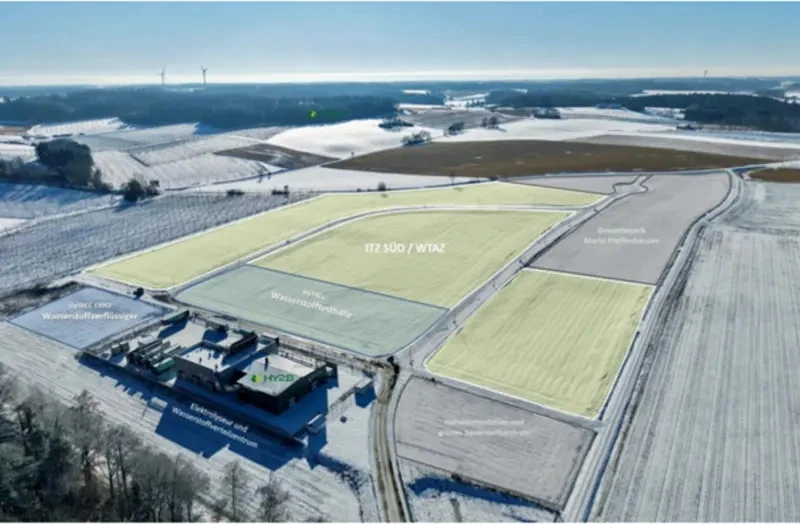
Site layout of the Hydrogen Technology Application Centre (WTAZ, ITZ South) in Pfeffenhausen, featuring the HyTACC CRYO hydrogen liquefier and the HyTACC hydrogen test hall surrounding the Hy2B electrolyser for green hydrogen (Image: HyTACC).

![[Translate to English:] Logo Akkreditierungsrat: Systemakkreditiert](/fileadmin/_processed_/2/8/csm_AR-Siegel_Systemakkreditierung_bc4ea3377d.webp)