
A low murmur of voices fills the auditorium, cameras flash and a tense anticipation fills the air. Around 200 representatives from science and politics have come together to celebrate a special moment: the Bavarian doctoral centres are honouring their first graduates. They represent a new chapter in research in Bavaria. With the Bavarian Higher Education Innovation Act of 2023, Bavarian UASs were granted independent doctoral rights in particularly research-intensive areas. This heralded a new era of application-oriented research - an important step towards strengthening the research landscape in the long term. Science Minister Markus Blume on the occasion of the first doctoral degrees: "Today we are celebrating a piece of Bavarian scientific history: at our universities of applied sciences and technical universities, it is now possible for the first time to complete a doctorate in particularly research-intensive areas at independent doctoral centres - and with excellence! This is research with a down-to-earth approach and passion. Those who do their doctorate here are not researching in an ivory tower, but in the centre of life - and are moving Bavaria forwards. With the doctoral centres, we have opened a new chapter in research: diversity, responsibility and trust as the foundation for the excellence of tomorrow. The first doctoral graduates are an impressive demonstration of the potential that lies in our scientific state of Bavaria - my heartfelt congratulations go to them!" In his welcoming address, THI President Professor Walter Schober, Chairman of Hochschule Bayern, the association of 19 Bavarian universities of applied sciences, emphasised the importance of the right to award doctorates at universities of applied sciences to strengthen Bavaria's innovative power. Stephanie Jacobs, Head of Office at the Bavarian State Ministry of Science and the Arts, recognised the HAW/TH as drivers of innovation and social progress. Professor Matthias Kleiner, chairman of the expert commission that assessed the establishment of the doctoral centres at the HAW/TH in Bavaria, emphasised the dynamism and quality of the Bavarian model: it is an outstanding example of how scientific excellence and practical relevance complement each other. The focus of the event was the presentation of certificates to the academic directors of the 22 doctoral centres. These cover a broad spectrum - from advanced building technologies and digital innovations to transformation and sustainable development - and together form a strong network for future-oriented research. The first graduates to successfully complete their dissertations in the newly established university centres were honoured in particular:
They all stand for the scientific awakening at Bavaria's universities - for research that is practical, interdisciplinary and socially relevant. |
First graduates of the doctoral centres of the Bavarian universities of applied sciences honoured
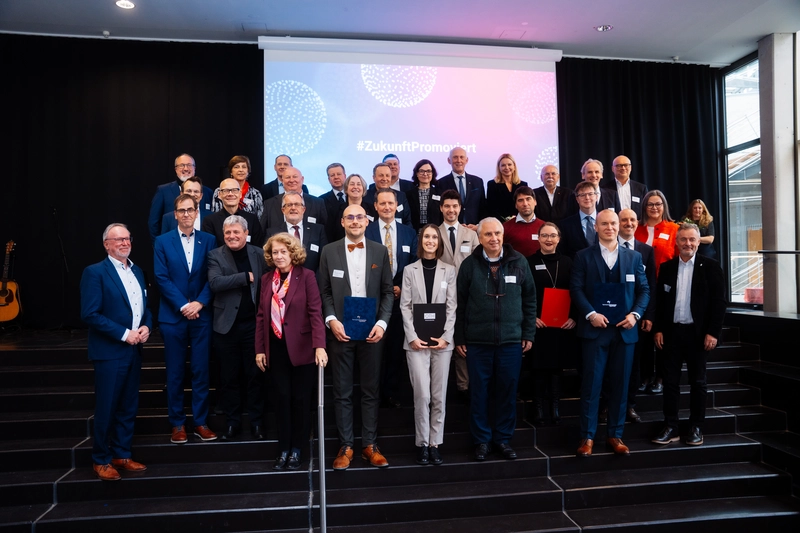
They have made history: Representatives of the 22 Bavarian doctoral centres and the first graduates, together with Stephanie Jacobs, Head of Office at the Bavarian State Ministry of Science and the Arts (back row, 4th from right), Professor Walter Schober, Chair of Hochschule Bayern (back row, 5th from right), and Professor Matthias Kleiner, Chair of the Expert Commission (back row, 3rd from right) (Photo: Simon Kahner).
![[Translate to English:] Logo Akkreditierungsrat: Systemakkreditiert](/fileadmin/_processed_/2/8/csm_AR-Siegel_Systemakkreditierung_bc4ea3377d.webp)