
IT management
IT management
IT professionals are increasingly working at the interface between IT and management, particularly in the course of digitalisation. This involves efficiently supporting demanding operational tasks through the use of suitable IT solutions or designing and successfully implementing digital business models. This requires knowledge in the field of digitalisation and comprehensive management skills.
Curriculum IT management
1st Semester
Credit modules: Selected aspects, instruments, tasks and processes of IT management / methodological competence / personal and social competence in the workplace
Operational management
The module provides fundamentals of operational management with a focus on key business functions. Topics include marketing, controlling, and finance, as well as basic economic principles and market mechanisms. A business simulation enables the practical application of management decisions and enhances understanding of business interrelationships.
Strategic management
The module provides fundamentals of strategic management with a focus on innovation management and sustainable competitive advantages. Topics include selected methods and tools for strategy development, international aspects of strategic decision-making, and the analysis and development of business cases. The focus lies on designing and implementing future-oriented business strategies.
Leadership
The module provides fundamentals of modern leadership with a focus on classical, digital, and intercultural approaches. Topics include leading employees and teams in different contexts as well as developing competencies for new leadership roles. The focus lies on effective, value-driven, and future-oriented leadership.
Operational IT management
The module provides fundamentals of operational IT management with a focus on digital business models, IT architecture, information security, and IT services. Topics include business model innovation, architecture management, IT security management, and IT service management. In addition, current developments, methods, and tools for the efficient design and management of IT processes are covered.
Process management and automation
The module provides fundamentals of process management and process automation. Topics include process modeling with BPMN, business process management cycles, process controlling, and performance indicators. In addition, change and risk management, process mining, and automation solutions such as robotic process automation (RPA) are covered to optimize business processes.
Strategic IT management
The module provides fundamentals of strategic IT management with a focus on IT strategy, IT governance, and IT organization. Topics include the development and alignment of IT strategies, governance frameworks such as COBIT, and the design of modern IT organizations in the context of digital transformation. In addition, methods and tools for managing IT value contribution are covered.
Artificial intelligence
The module provides fundamentals of artificial intelligence with a focus on key concepts, methods, and applications. Topics include search algorithms, knowledge representation, inference, machine learning, and neural networks. In addition, the implementation and evaluation of AI systems as well as ethical, societal, and current research aspects of artificial intelligence are covered.
Digital technologies and trends
The module provides fundamentals of current digital technologies and trends in a business context. Topics include back-end technologies, modern digital business architectures such as microservices, and API-based ecosystems. In addition, trend-scouting methods, relevant emerging technologies, and their application in product development and digital business models are covered.
Project
The module provides practical methods for user-centered development of digital products and services. Topics include the analysis of usage contexts and user requirements, methods such as personas and customer journey mapping, as well as prototyping and evaluation. Students develop and test their own solution concepts and apply UX and usability methods to real-world use cases.
Master thesis
The module involves the independent scientific investigation of a problem at the interface between the program’s specialization and management, or with a focus on one of these fields. The aim is to develop, analyze, and evaluate practice-oriented solutions using scientific methods and to present the results in a structured and comprehensible manner.
| 1. Semester | |
|---|---|
| 2. Semester | |
| 3. Semester | |
| 4. Semester | |
| 5. Semester |
Admission requirements:
A first domestic or foreign university degree with at least 210 ECTS credit points is required for admission to the MBA programme.
Furthermore, at least one year of professional practice in the IT sector, in IT-related areas or in the field of business administration is required.
The admission requirements according to the Bavarian Higher Education Act generally apply.
Admission option for a university degree with fewer than 210 ECTS credit points:
If you have a university degree with fewer than 210 ECTS credits or your degree is recognised as having fewer than 210 ECTS credits, there is the option of having up to 30 ECTS credits from qualified professional experience credited.
Counselling and application:
For individual counselling before and during the application phase, please get in touch with the named contact persons at the Campus for Continuing Education. The relevant contact details can be found on this page.
Applications for this degree programme are made online.
There you will receive all relevant information on the application formalities and have the opportunity to track your application progress online.
The application period for the summer semester begins on 15 November, for the winter semester on 2 May of each year.
University entrance qualification acquired abroad
If the higher education entrance qualification was obtained abroad, a preliminary examination of the higher education entrance qualification by uni-assist is required.
Please note that it may take 4 to 6 weeks for uni-assist to process your application.
You can find further information on applying to university from abroad on the website Applying to university from abroad.
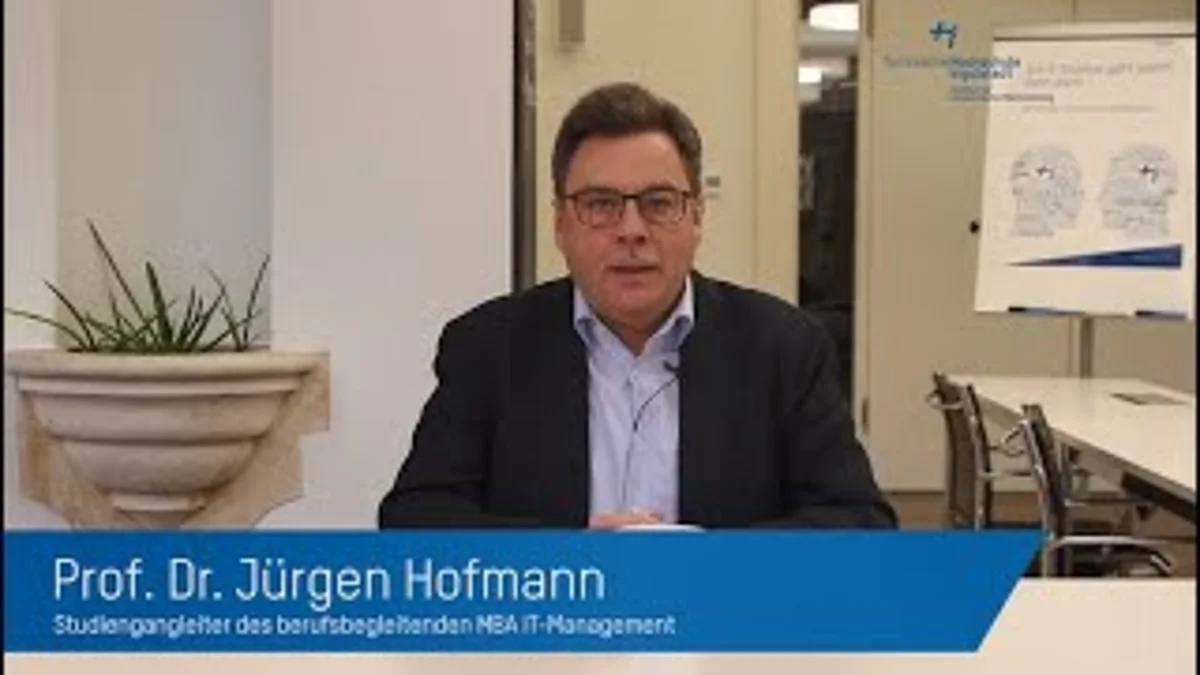
What characterises the MBA IT Management at the IAW
Any questions?
Do you have any questions about applications, admission, enrolment, student finance, accommodation or other general topics? If so, please use our contact form and select the relevant topic. This will ensure your enquiry is sent directly to the relevant contact person(s) and can be answered quickly and effectively.
Study programme director

Study programme supervisor

Other programmes you may be interested in
-

Strategy, Global Risk & Security Management
Master of Business Administration (MBA)
Geopolitical uncertainties, cyber risks and global crises present companies with new challenges. The MBA in Strategy, Global Risk & Security Management combines strategic management with expertise in risk and security, and prepares you for roles of responsibility in the areas of resilience, governance and corporate security.
About the degree program -
Applied artificial intelligence
Master of Science (M. Sc.)
Shape the intelligent technologies of tomorrow: The Applied Artificial Intelligence master's program provides advanced expertise in machine learning, data science, and AI applications. Work on real-world challenges and prepare for demanding roles in industry, research, and development.
About the degree program -
Digital Business Management
Master of Business Administration (MBA)
Digital transformation presents companies with new strategic and organisational challenges. The MBA in Digital Business Management combines management expertise with digital know-how, equipping students to successfully shape change processes, innovations and digital business models.
About the degree program -
Industrial Engineering Digitalisation
Master of Science (M. Sc.)
Digital technologies are transforming products, processes and entire business models. The Industrial Engineering Digitalisation degree programme combines technical expertise with management skills and prepares you to shape Industry 4.0, data-driven processes and digital transformation projects.
About the degree program


IT management
IT professionals are increasingly working at the interface between IT and management, particularly in the course of digitalisation. This involves efficiently supporting demanding operational tasks through the use of suitable IT solutions or designing and successfully implementing digital business models. This requires knowledge in the field of digitalisation and comprehensive management skills.
Curriculum IT management
1st Semester
Credit modules: Selected aspects, instruments, tasks and processes of IT management / methodological competence / personal and social competence in the workplace
Operational management
The module provides fundamentals of operational management with a focus on key business functions. Topics include marketing, controlling, and finance, as well as basic economic principles and market mechanisms. A business simulation enables the practical application of management decisions and enhances understanding of business interrelationships.
Strategic management
The module provides fundamentals of strategic management with a focus on innovation management and sustainable competitive advantages. Topics include selected methods and tools for strategy development, international aspects of strategic decision-making, and the analysis and development of business cases. The focus lies on designing and implementing future-oriented business strategies.
Leadership
The module provides fundamentals of modern leadership with a focus on classical, digital, and intercultural approaches. Topics include leading employees and teams in different contexts as well as developing competencies for new leadership roles. The focus lies on effective, value-driven, and future-oriented leadership.
Operational IT management
The module provides fundamentals of operational IT management with a focus on digital business models, IT architecture, information security, and IT services. Topics include business model innovation, architecture management, IT security management, and IT service management. In addition, current developments, methods, and tools for the efficient design and management of IT processes are covered.
Process management and automation
The module provides fundamentals of process management and process automation. Topics include process modeling with BPMN, business process management cycles, process controlling, and performance indicators. In addition, change and risk management, process mining, and automation solutions such as robotic process automation (RPA) are covered to optimize business processes.
Strategic IT management
The module provides fundamentals of strategic IT management with a focus on IT strategy, IT governance, and IT organization. Topics include the development and alignment of IT strategies, governance frameworks such as COBIT, and the design of modern IT organizations in the context of digital transformation. In addition, methods and tools for managing IT value contribution are covered.
Artificial intelligence
The module provides fundamentals of artificial intelligence with a focus on key concepts, methods, and applications. Topics include search algorithms, knowledge representation, inference, machine learning, and neural networks. In addition, the implementation and evaluation of AI systems as well as ethical, societal, and current research aspects of artificial intelligence are covered.
Digital technologies and trends
The module provides fundamentals of current digital technologies and trends in a business context. Topics include back-end technologies, modern digital business architectures such as microservices, and API-based ecosystems. In addition, trend-scouting methods, relevant emerging technologies, and their application in product development and digital business models are covered.
Project
The module provides practical methods for user-centered development of digital products and services. Topics include the analysis of usage contexts and user requirements, methods such as personas and customer journey mapping, as well as prototyping and evaluation. Students develop and test their own solution concepts and apply UX and usability methods to real-world use cases.
Master thesis
The module involves the independent scientific investigation of a problem at the interface between the program’s specialization and management, or with a focus on one of these fields. The aim is to develop, analyze, and evaluate practice-oriented solutions using scientific methods and to present the results in a structured and comprehensible manner.
| 1. Semester | |
|---|---|
| 2. Semester | |
| 3. Semester | |
| 4. Semester | |
| 5. Semester |
Admission requirements:
A first domestic or foreign university degree with at least 210 ECTS credit points is required for admission to the MBA programme.
Furthermore, at least one year of professional practice in the IT sector, in IT-related areas or in the field of business administration is required.
The admission requirements according to the Bavarian Higher Education Act generally apply.
Admission option for a university degree with fewer than 210 ECTS credit points:
If you have a university degree with fewer than 210 ECTS credits or your degree is recognised as having fewer than 210 ECTS credits, there is the option of having up to 30 ECTS credits from qualified professional experience credited.
Counselling and application:
For individual counselling before and during the application phase, please get in touch with the named contact persons at the Campus for Continuing Education. The relevant contact details can be found on this page.
Applications for this degree programme are made online.
There you will receive all relevant information on the application formalities and have the opportunity to track your application progress online.
The application period for the summer semester begins on 15 November, for the winter semester on 2 May of each year.
University entrance qualification acquired abroad
If the higher education entrance qualification was obtained abroad, a preliminary examination of the higher education entrance qualification by uni-assist is required.
Please note that it may take 4 to 6 weeks for uni-assist to process your application.
You can find further information on applying to university from abroad on the website Applying to university from abroad.
What characterises the MBA IT Management at the IAW
Any questions?
Do you have any questions about applications, admission, enrolment, student finance, accommodation or other general topics? If so, please use our contact form and select the relevant topic. This will ensure your enquiry is sent directly to the relevant contact person(s) and can be answered quickly and effectively.
Study programme director
Study programme supervisor
Other programmes you may be interested in
-
Strategy, Global Risk & Security Management
Master of Business Administration (MBA)
Geopolitical uncertainties, cyber risks and global crises present companies with new challenges. The MBA in Strategy, Global Risk & Security Management combines strategic management with expertise in risk and security, and prepares you for roles of responsibility in the areas of resilience, governance and corporate security.
About the degree program -
Applied artificial intelligence
Master of Science (M. Sc.)
Shape the intelligent technologies of tomorrow: The Applied Artificial Intelligence master's program provides advanced expertise in machine learning, data science, and AI applications. Work on real-world challenges and prepare for demanding roles in industry, research, and development.
About the degree program -
Digital Business Management
Master of Business Administration (MBA)
Digital transformation presents companies with new strategic and organisational challenges. The MBA in Digital Business Management combines management expertise with digital know-how, equipping students to successfully shape change processes, innovations and digital business models.
About the degree program -
Industrial Engineering Digitalisation
Master of Science (M. Sc.)
Digital technologies are transforming products, processes and entire business models. The Industrial Engineering Digitalisation degree programme combines technical expertise with management skills and prepares you to shape Industry 4.0, data-driven processes and digital transformation projects.
About the degree program