Sensor Networks Technologies and Sensor Data Fusion
Covers sensor networks, communication, signal processing, and fusion techniques, including SLAM and AI-based methods for multi-sensor integration.

This English-taught Master’s programme will train you to become an expert in the development of intelligent systems that can learn from data, adapt accordingly and make independent decisions to optimise overall performance.
During the Master’s programme, you will combine the building blocks of modern autonomous systems – such as environmental sensing via sensor networks and data fusion, data engineering, cloud computing and communications technology – with system perception, image processing, machine learning and decision-making methods. You will take compulsory modules from the following three areas: Intelligent Perception and Exploration, Planning, Control and Decision-Making, and Software Methods and Systems Development. You will work on group projects with students from all over the world – ideal preparation for future work in international teams.
Throughout your Master’s programme, you will be supported by our experienced professors, who, as experts in the field of artificial intelligence, are also members of the official Bavarian AI mobility hub, AImotion. After completing your Master’s degree in AI Engineering of Autonomous Systems, a wide range of career opportunities awaits you across numerous industries.
By the end of this program, you will have the skills and knowledge to design and implement intelligent systems that can learn from data, adapt accordingly, and make decisions that optimise overall performance. You will be able to develop autonomous systems that can provide new functionalities, enhance safety, and improve efficiency in a wide range of industries, e.g., mobility, production, logistics, agriculture and medical engineering.
We believe that autonomous systems will play a crucial role in shaping our world. We will be excited to accompany you on this journey, and we are committed to providing you with the support and resources you need to succeed. So come and join us and be a part of the revolution in AI engineering of autonomous systems!
Online Master-Talk for prospective students on 11 November 2026 at 10 a.m.
<p>Covers sensor networks, communication, signal processing, and fusion techniques, including SLAM and AI-based methods for multi-sensor integration. <br /> </p>
<p><span style="font-family:"Times New Roman",serif;font-size:12.0pt;line-height:107%;">Teaches modeling and simulation of dynamic systems, parameter estimation, and validation using analytical and numerical methods with tools like MATLAB/Simulink.</span></p>
<p><span style="font-family:"Times New Roman",serif;font-size:12.0pt;line-height:107%;">Introduces data processing, visualization, and machine learning fundamentals, including model evaluation and inference for linear and non-linear models.</span></p>
<p><span style="font-family:"Times New Roman",serif;font-size:12.0pt;line-height:107%;">Covers hardware/software co-design, optimization, and deployment of algorithms—especially AI models—on resource-constrained edge devices.</span></p>
<p><span style="font-family:"Times New Roman",serif;font-size:12.0pt;line-height:107%;">Covers perception systems and AI methods, including imaging, LiDAR, neural networks, transformers, and language-vision models. Focuses on applying these techniques to robotics and autonomous systems.</span></p>
<p><span style="font-family:"Times New Roman",serif;font-size:12.0pt;line-height:107%;">Focuses on decision-making under uncertainty using MDPs, planning, and reinforcement learning, and designing safe autonomous systems.</span></p>
<p><span style="font-family:"Times New Roman",serif;font-size:12.0pt;line-height:107%;">Explains computing architectures and communication systems supporting autonomous systems, including processors, interconnects, and network protocols.</span></p>
<p><span style="font-family:"Times New Roman",serif;font-size:12.0pt;line-height:107%;">Independent research project applying scientific methods to solve complex engineering problems, including documentation, evaluation, and presentation.</span></p>
| 1. Semester | |
|---|---|
| 2. Semester | |
| 3. Semester |
The study programme consists of compulsory modules in the following areas:
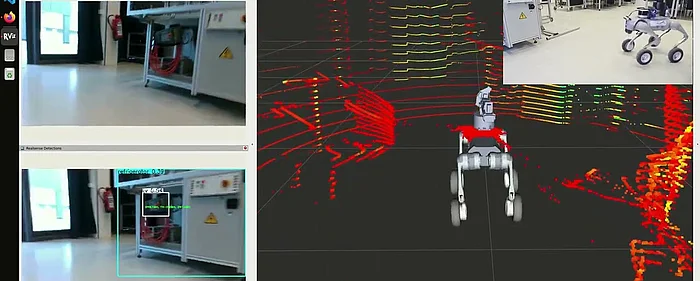
Sensors are the sensory organs of autonomous systems, key to their mobility and autonomy. Data from multiple and even different sensors are combined to quickly and accurately communicate information about the environment, physical events, activities or situations to decision-making components.
Planning with intelligence is a prerequisite for autonomous and predictive action. Systems need to be able to plan their actions in order to achieve a given goal and to respond to unexpected or new situations by changing their behaviour. Machine learning methods are used to combine sensory data with past experience and draw conclusions that can be used to improve actions.
The development of autonomous systems is approached from a software engineering perspective. Various characteristics of autonomous systems, architectures, models and languages will be covered in order to demonstrate the technical feasibility of systems that can dynamically adapt their behaviour to changes in operating conditions by means of software.
The compulsory part is complemented by elective modules. These modules focus on specific aspects of the development of autonomous systems, automotive applications, innovation management, or engineering processes applied in tech companies as well as German language courses.
The Research Methods module is taught every semester. It allows students to apply scientific research methods to a state-of-the-art topic in AI engineering. The topic will be presented and discussed with peers and summarised in a seminar paper.
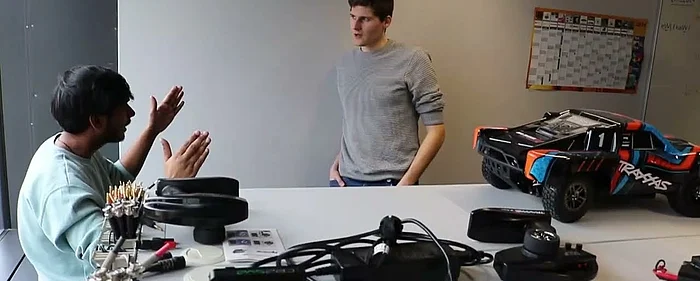
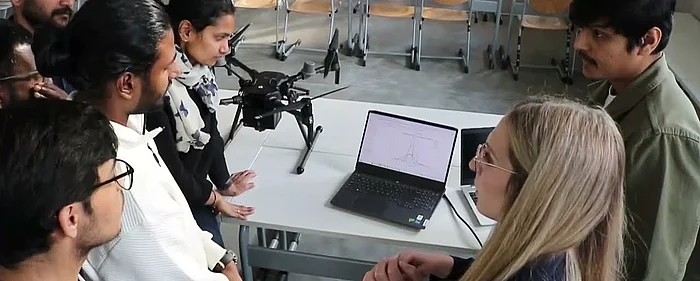
The Group Project provides students with an experience of 'learning by doing' and collaboration in a team of their peers. They start by receiving and defining an engineering problem, from which they design, implement and test using their acquired engineering skills. The team is under the guidance of a mentor throughout the project. A project presentation and a summary paper are the culmination of the project work.
Admission to this programme is based on a successfully completed Bachelor's degree in electrical engineering, computer science, or mathematics (or a discipline of each) totalling 210 ECTS. In case of a Bachelor's degree with less than 210 but at least 180 ECTS, missing competences need to be proved (e.g., by additional passed exams or internships).
You can start your studies in the summer semester or in the winter semester. The application is made via the PRIMUSS application portal THI. Master's degree applicants with relevant previous studies outside Germany require a preliminary verification document (VPD) from uni-assist.
Information on the application period and the application procedure can be found on the page "Application for a Master's study place".


Since the programme is entirely taught in English, mastery of the English language is required and must be demonstrated. If your language of instruction (MOI) in undergraduate studies was English, you do not need to provide additional evidence of English proficiency. If your MOI in college was not English, you must provide IELTS, Cambridge, TOEFL or similar certificates.
The programme is entirely taught in English. But students are recommended to learn German parallel to their studies, as this will be an advantage when looking for a job after graduation. German courses are offered as General Elective module.
There are various scholarships for enrolled students, such as, e.g., the Deutschlandstipendium. All students must apply and apply for certain scholarships themselves. Most scholarship programmes are performance-based (grades, voluntary work, etc.). The economic situation of the applicants is usually not taken into account. For many scholarships, a certain level of German language skills (at least B2) is required.
Enrolment can be done remotely. Enrolment must be completed within the first 4 weeks of the semester.
We do not offer online courses. For most courses, all materials are available online for self-study. Some modules require physical attendance.
It is not possible to defer your admission to a later semester. Once you have completed the enrolment process, you are a full student of THI, regardless of whether you are physically in Ingolstadt or attending courses.
In order to take the examinations, you must be present in Ingolstadt. Please note that your study time will not be extended if you cannot be present in Ingolstadt for lectures or exams once you are enrolled.
If you would like to apply for our AI Engineering of Autonomous Systems programme and work in a company at the same time, please apply to a company near Ingolstadt that has the same focus as our degree programme. We do not yet have a list of possible companies.
You can find all relevant information on the following page: Dual Studies (THI).
Unfortunately, neither the head of degree programme nor the faculty can help you find accommodation.
An International Welcome Centre will be set up from service fees to provide you with support (incomings@thi.de).
Do you have any questions about applications, admission, enrolment, student finance, accommodation or other general topics? If so, please use our contact form and select the relevant topic. This will ensure your enquiry is sent directly to the relevant contact person(s) and can be answered quickly and effectively.
Programme director "AI Engineering of Autonomous Systems" (Master)


Master of Engineering (M. Eng.)
Autonomous vehicles and self-driving systems are set to transform the future of mobility. Ensuring the safety of all road users remains a key priority in this rapidly evolving field. In this Master’s programme, you will deepen your expertise in computer science and engineering while exploring the technologies behind automated and connected driving. Studying at one of Bavaria’s leading research universities, you will engage with cutting-edge developments in areas such as artificial intelligence, sensor technologies, vehicle systems, and autonomous mobility, preparing you for advanced roles in research, development, and the automotive industry.
About the degree program
Bachelor of Engineering (B. Eng.)
Autonomous, mobile, intelligent: Robots are indispensible in making many production processes possible in the first place. In combination with AI applications, they are becoming suitable for everyday use - help develop the latest generations, study the German language Bachelor Robotics in the heart of Bavaria's industrial region!
About the degree program
Master of Engineering (M. Eng.)
Key areas in Intelligent Aerial Systems include aeronautics, autonomous systems, sensor technology and artificial intelligence. The programme brings together navigation, flight control and intelligent mission planning. The result is the integration of smart functionality into unmanned aerial systems.
About the degree programThis English-taught Master’s programme will train you to become an expert in the development of intelligent systems that can learn from data, adapt accordingly and make independent decisions to optimise overall performance.
During the Master’s programme, you will combine the building blocks of modern autonomous systems – such as environmental sensing via sensor networks and data fusion, data engineering, cloud computing and communications technology – with system perception, image processing, machine learning and decision-making methods. You will take compulsory modules from the following three areas: Intelligent Perception and Exploration, Planning, Control and Decision-Making, and Software Methods and Systems Development. You will work on group projects with students from all over the world – ideal preparation for future work in international teams.
Throughout your Master’s programme, you will be supported by our experienced professors, who, as experts in the field of artificial intelligence, are also members of the official Bavarian AI mobility hub, AImotion. After completing your Master’s degree in AI Engineering of Autonomous Systems, a wide range of career opportunities awaits you across numerous industries.
By the end of this program, you will have the skills and knowledge to design and implement intelligent systems that can learn from data, adapt accordingly, and make decisions that optimise overall performance. You will be able to develop autonomous systems that can provide new functionalities, enhance safety, and improve efficiency in a wide range of industries, e.g., mobility, production, logistics, agriculture and medical engineering.
We believe that autonomous systems will play a crucial role in shaping our world. We will be excited to accompany you on this journey, and we are committed to providing you with the support and resources you need to succeed. So come and join us and be a part of the revolution in AI engineering of autonomous systems!
Online Master-Talk for prospective students on 11 November 2026 at 10 a.m.
<p>Covers sensor networks, communication, signal processing, and fusion techniques, including SLAM and AI-based methods for multi-sensor integration. <br /> </p>
<p><span style="font-family:"Times New Roman",serif;font-size:12.0pt;line-height:107%;">Teaches modeling and simulation of dynamic systems, parameter estimation, and validation using analytical and numerical methods with tools like MATLAB/Simulink.</span></p>
<p><span style="font-family:"Times New Roman",serif;font-size:12.0pt;line-height:107%;">Introduces data processing, visualization, and machine learning fundamentals, including model evaluation and inference for linear and non-linear models.</span></p>
<p><span style="font-family:"Times New Roman",serif;font-size:12.0pt;line-height:107%;">Covers hardware/software co-design, optimization, and deployment of algorithms—especially AI models—on resource-constrained edge devices.</span></p>
<p><span style="font-family:"Times New Roman",serif;font-size:12.0pt;line-height:107%;">Covers perception systems and AI methods, including imaging, LiDAR, neural networks, transformers, and language-vision models. Focuses on applying these techniques to robotics and autonomous systems.</span></p>
<p><span style="font-family:"Times New Roman",serif;font-size:12.0pt;line-height:107%;">Focuses on decision-making under uncertainty using MDPs, planning, and reinforcement learning, and designing safe autonomous systems.</span></p>
<p><span style="font-family:"Times New Roman",serif;font-size:12.0pt;line-height:107%;">Explains computing architectures and communication systems supporting autonomous systems, including processors, interconnects, and network protocols.</span></p>
<p><span style="font-family:"Times New Roman",serif;font-size:12.0pt;line-height:107%;">Independent research project applying scientific methods to solve complex engineering problems, including documentation, evaluation, and presentation.</span></p>
| 1. Semester | |
|---|---|
| 2. Semester | |
| 3. Semester |
The study programme consists of compulsory modules in the following areas:
Sensors are the sensory organs of autonomous systems, key to their mobility and autonomy. Data from multiple and even different sensors are combined to quickly and accurately communicate information about the environment, physical events, activities or situations to decision-making components.
Planning with intelligence is a prerequisite for autonomous and predictive action. Systems need to be able to plan their actions in order to achieve a given goal and to respond to unexpected or new situations by changing their behaviour. Machine learning methods are used to combine sensory data with past experience and draw conclusions that can be used to improve actions.
The development of autonomous systems is approached from a software engineering perspective. Various characteristics of autonomous systems, architectures, models and languages will be covered in order to demonstrate the technical feasibility of systems that can dynamically adapt their behaviour to changes in operating conditions by means of software.
The compulsory part is complemented by elective modules. These modules focus on specific aspects of the development of autonomous systems, automotive applications, innovation management, or engineering processes applied in tech companies as well as German language courses.
The Research Methods module is taught every semester. It allows students to apply scientific research methods to a state-of-the-art topic in AI engineering. The topic will be presented and discussed with peers and summarised in a seminar paper.
The Group Project provides students with an experience of 'learning by doing' and collaboration in a team of their peers. They start by receiving and defining an engineering problem, from which they design, implement and test using their acquired engineering skills. The team is under the guidance of a mentor throughout the project. A project presentation and a summary paper are the culmination of the project work.
Admission to this programme is based on a successfully completed Bachelor's degree in electrical engineering, computer science, or mathematics (or a discipline of each) totalling 210 ECTS. In case of a Bachelor's degree with less than 210 but at least 180 ECTS, missing competences need to be proved (e.g., by additional passed exams or internships).
You can start your studies in the summer semester or in the winter semester. The application is made via the PRIMUSS application portal THI. Master's degree applicants with relevant previous studies outside Germany require a preliminary verification document (VPD) from uni-assist.
Information on the application period and the application procedure can be found on the page "Application for a Master's study place".
Since the programme is entirely taught in English, mastery of the English language is required and must be demonstrated. If your language of instruction (MOI) in undergraduate studies was English, you do not need to provide additional evidence of English proficiency. If your MOI in college was not English, you must provide IELTS, Cambridge, TOEFL or similar certificates.
The programme is entirely taught in English. But students are recommended to learn German parallel to their studies, as this will be an advantage when looking for a job after graduation. German courses are offered as General Elective module.
There are various scholarships for enrolled students, such as, e.g., the Deutschlandstipendium. All students must apply and apply for certain scholarships themselves. Most scholarship programmes are performance-based (grades, voluntary work, etc.). The economic situation of the applicants is usually not taken into account. For many scholarships, a certain level of German language skills (at least B2) is required.
Enrolment can be done remotely. Enrolment must be completed within the first 4 weeks of the semester.
We do not offer online courses. For most courses, all materials are available online for self-study. Some modules require physical attendance.
It is not possible to defer your admission to a later semester. Once you have completed the enrolment process, you are a full student of THI, regardless of whether you are physically in Ingolstadt or attending courses.
In order to take the examinations, you must be present in Ingolstadt. Please note that your study time will not be extended if you cannot be present in Ingolstadt for lectures or exams once you are enrolled.
If you would like to apply for our AI Engineering of Autonomous Systems programme and work in a company at the same time, please apply to a company near Ingolstadt that has the same focus as our degree programme. We do not yet have a list of possible companies.
You can find all relevant information on the following page: Dual Studies (THI).
Unfortunately, neither the head of degree programme nor the faculty can help you find accommodation.
An International Welcome Centre will be set up from service fees to provide you with support (incomings@thi.de).
Do you have any questions about applications, admission, enrolment, student finance, accommodation or other general topics? If so, please use our contact form and select the relevant topic. This will ensure your enquiry is sent directly to the relevant contact person(s) and can be answered quickly and effectively.
Programme director "AI Engineering of Autonomous Systems" (Master)
Master of Engineering (M. Eng.)
Autonomous vehicles and self-driving systems are set to transform the future of mobility. Ensuring the safety of all road users remains a key priority in this rapidly evolving field. In this Master’s programme, you will deepen your expertise in computer science and engineering while exploring the technologies behind automated and connected driving. Studying at one of Bavaria’s leading research universities, you will engage with cutting-edge developments in areas such as artificial intelligence, sensor technologies, vehicle systems, and autonomous mobility, preparing you for advanced roles in research, development, and the automotive industry.
About the degree program
Bachelor of Engineering (B. Eng.)
Autonomous, mobile, intelligent: Robots are indispensible in making many production processes possible in the first place. In combination with AI applications, they are becoming suitable for everyday use - help develop the latest generations, study the German language Bachelor Robotics in the heart of Bavaria's industrial region!
About the degree program
Master of Engineering (M. Eng.)
Key areas in Intelligent Aerial Systems include aeronautics, autonomous systems, sensor technology and artificial intelligence. The programme brings together navigation, flight control and intelligent mission planning. The result is the integration of smart functionality into unmanned aerial systems.
About the degree program