Skip to content

Engineering and Management

Bachelor of Engineering (B. Eng.)

How do you combine engineering expertise and management skills for a global career?

The English-taught Bachelor’s degree programme in Engineering and Management combines engineering with business management expertise. You will gain in-depth knowledge in areas such as mechanics, computer science, electronics and software development, as well as in accounting, marketing and management control. Complemented by key soft skills, the programme will equip you to take on a wide range of roles at the interface between technology and management in international companies.

Engineering and Management

If you want to develop technological innovations while understanding how businesses operate in a global environment, the Bachelor’s programme in Engineering and Management is the ideal choice. You will gain a broad engineering education covering subjects such as engineering mechanics, materials science, electrical engineering, computer science, software development, and mathematics. At the same time, you will build a solid foundation in business disciplines including accounting, marketing, and controlling, enabling you to evaluate technical projects from both an engineering and a commercial perspective.

Project-based learning helps you strengthen essential professional skills such as teamwork, communication, and presentation, preparing you for international working environments. Modules in Intercultural Studies, International Management, and a second foreign language enhance your global mindset and intercultural competence. An international semester abroad and an industry placement in the fifth semester provide valuable practical experience and direct exposure to global business environments. As the entire programme is taught in English, graduates are exceptionally well prepared for careers with internationally operating companies at the intersection of technology, innovation, and management.

Career Opportunities


The degree programme opens up a wide range of career prospects at the interface between technology and management. Graduates take on roles, for example, in international product management, industrial engineering or the management of international projects. Other areas of work include strategic procurement, international sales of technical products, management consultancy, and globally oriented roles such as IT, planning or procurement. Furthermore, the programme prepares students for demanding assistant and coordination roles in management, as well as for future leadership responsibilities in internationally active companies.



Apply online
Degree
Bachelor of Engineering (B. Eng.)
Duration
7 Semester
Start of studies
Winter
Main teaching language
English
Admission restricted
Yes
Type of degree program
Full-time
ECTS
210
Accreditation
Yes

Application period for the winter semester 2027/28: April 1 to July 15, 2027

Curriculum Engineering and Management

Presentation of curriculums
Semester
1st Semester
  1. Mathematics 1

    Introduces core mathematical tools for engineers, including calculus, complex numbers, series, and functions. Students develop analytical thinking and problem-solving skills required to model and solve engineering problems with confidence.

  2. Computer Science

    Covers fundamentals of computing, data processing, networks, and cybersecurity. Students learn Python programming, including control structures, object-oriented design, and data analysis libraries for practical engineering applications.

  3. Economics

  4. Business Administration

    Introduces core business disciplines such as company organization, human resources, micro- and macroeconomics, and monetary policy. Students learn to analyze markets and assess economic impacts on business decisions.

  5. Start-Up Project

    Practice-oriented project including simulations and teamwork, fostering entrepreneurial thinking and innovative business ideas.

  6. Foreign Language 1

Mathematics 1

<p>Introduces core mathematical tools for engineers, including calculus, complex numbers, series, and functions. Students develop analytical thinking and problem-solving skills required to model and solve engineering problems with confidence.</p>

Computer Science

<p>Covers fundamentals of computing, data processing, networks, and cybersecurity. Students learn Python programming, including control structures, object-oriented design, and data analysis libraries for practical engineering applications.</p>

Economics

Business Administration

<p>Introduces core business disciplines such as company organization, human resources, micro- and macroeconomics, and monetary policy. Students learn to analyze markets and assess economic impacts on business decisions.</p>

Start-Up Project

<p>Practice-oriented project including simulations and teamwork, fostering entrepreneurial thinking and innovative business ideas.</p>

Foreign Language 1

  1. Mathematics 2

    Builds on Mathematics 1 with linear algebra, differential equations, multivariable calculus, and vector analysis. The module strengthens the ability to apply advanced mathematical methods to engineering and scientific challenges.

  2. Mechanical Design

  3. Physics

    Covers fundamental physical concepts such as mechanics, thermodynamics, and fluid mechanics, combining theory with experiments and technical applications.

  4. Manufacturing Technologies

  5. Financial Accounting

    Provides an introduction to financial reporting under German GAAP and IFRS. Students learn to prepare and analyze balance sheets, income statements, cash-flow statements, and annual reports.

  6. Foreign Language 2

Mathematics 2

<p>Builds on Mathematics 1 with linear algebra, differential equations, multivariable calculus, and vector analysis. The module strengthens the ability to apply advanced mathematical methods to engineering and scientific challenges.</p>

Mechanical Design

Physics

<p>Covers fundamental physical concepts such as mechanics, thermodynamics, and fluid mechanics, combining theory with experiments and technical applications.</p>

Manufacturing Technologies

Financial Accounting

<p>Provides an introduction to financial reporting under German GAAP and IFRS. Students learn to prepare and analyze balance sheets, income statements, cash-flow statements, and annual reports.</p>

Foreign Language 2

  1. Software Development

    Introduces software engineering principles using Python. Students design, implement, test, and debug applications, learning the full software development lifecycle and teamwork in technical projects.

  2. Electrical Engineering

    Introduces electrical and magnetic principles, DC and AC circuits, semiconductors and electronic components, forming a foundation for understanding technical systems and sustainable energy solutions.

  3. Engineering Mechanics

    Focuses on statics and strength of materials. Students analyze forces, moments, stresses, and deformations, forming a foundation for mechanical design and structural analysis.

  4. Automation Technologies

    Introduces automation systems, sensors, actuators, controllers, and industrial communication. Students learn to design and evaluate automated processes in modern industrial environments.

  5. Cost Accounting

    Introduces cost classification, absorption and variable costing, budgeting, and variance analysis. Students learn to support managerial decision-making through cost-focused analysis.

  6. Foreign Language 3

Software Development

<p>Introduces software engineering principles using Python. Students design, implement, test, and debug applications, learning the full software development lifecycle and teamwork in technical projects.</p>

Electrical Engineering

<p>Introduces electrical and magnetic principles, DC and AC circuits, semiconductors and electronic components, forming a foundation for understanding technical systems and sustainable energy solutions.</p>

Engineering Mechanics

<p>Focuses on statics and strength of materials. Students analyze forces, moments, stresses, and deformations, forming a foundation for mechanical design and structural analysis.</p>

Automation Technologies

<p>Introduces automation systems, sensors, actuators, controllers, and industrial communication. Students learn to design and evaluate automated processes in modern industrial environments.</p>

Cost Accounting

<p>Introduces cost classification, absorption and variable costing, budgeting, and variance analysis. Students learn to support managerial decision-making through cost-focused analysis.</p>

Foreign Language 3

  1. Materials Science

    This module examines the relationships between atomic structure, microstructure and the resulting material properties. Topics include crystallography, deformation, phase diagrams, heat treatment and materials testing for engineering applications.

  2. Production Systems

    Examines modern production systems, including machine tools, lean manufacturing, assembly, logistics, and digital production. Students learn to analyze efficiency, sustainability, and value creation in industrial production.

  3. Project and Quality Management

    Introduces project management methods and quality management systems. Students learn to plan, control, and evaluate projects while applying quality tools and agile approaches.

  4. Marketing

    Covers market-oriented management, segmentation, positioning, and the marketing mix. Students apply marketing tools to real-world cases, including B2B, B2C, and digital marketing contexts.

  5. Controlling

    Focuses on management accounting and strategic control. Students apply tools such as investment appraisal, budgeting, key performance indicators, and variance analysis to business cases.

  6. Selected Topics of International Management

    Analyzes international business environments, globalization, market entry strategies, and transfer pricing. Students gain insight into managing multinational enterprises and cross-border operations.

Materials Science

<p>This module examines the relationships between atomic structure, microstructure and the resulting material properties. Topics include crystallography, deformation, phase diagrams, heat treatment and materials testing for engineering applications.</p>

Production Systems

<p>Examines modern production systems, including machine tools, lean manufacturing, assembly, logistics, and digital production. Students learn to analyze efficiency, sustainability, and value creation in industrial production.</p>

Project and Quality Management

<p>Introduces project management methods and quality management systems. Students learn to plan, control, and evaluate projects while applying quality tools and agile approaches.</p>

Marketing

<p>Covers market-oriented management, segmentation, positioning, and the marketing mix. Students apply marketing tools to real-world cases, including B2B, B2C, and digital marketing contexts.</p>

Controlling

<p>Focuses on management accounting and strategic control. Students apply tools such as investment appraisal, budgeting, key performance indicators, and variance analysis to business cases.</p>

Selected Topics of International Management

<p>Analyzes international business environments, globalization, market entry strategies, and transfer pricing. Students gain insight into managing multinational enterprises and cross-border operations.</p>

  1. Industry Internship

    The internship semester, preferably in an international context, deepens the skills acquired during theoretical courseworks. It allows students to apply what they have learned and to gain professional experience. The 20-week internship must be performed during the second phase of the course after meeting the prerequisites for advancement. 

  2. Seminar

    A three-day intensive course focused on professional skills, including field trips, workshops, and seminars on topics such as facilitation, presentation, conflict management, public speaking, academic writing, and ethics.

  3. Elctive

Industry Internship

<p>The internship semester, preferably in an international context, deepens the skills acquired during theoretical courseworks. It allows students to apply what they have learned and to gain professional experience. The 20-week internship must be performed during the second phase of the course after meeting the prerequisites for advancement.&nbsp;</p>

Seminar

<p>A three-day intensive course focused on professional skills, including field trips, workshops, and seminars on topics such as facilitation, presentation, conflict management, public speaking, academic writing, and ethics.</p>

Elctive

  1. Statistics

  2. Production Planning & Logistics

    Covers production planning strategies, supply chain coordination, and performance indicators. Students learn to integrate planning systems with digital manufacturing and Industry 4.0 concepts.

  3. Project

    A team project integrating engineering and management perspectives. Students manage complex tasks, apply project management methods, and present solutions to practical problems.

  4. Electives

  5. Project

    A team project integrating engineering and management perspectives. Students manage complex tasks, apply project management methods, and present solutions to practical problems.

  6. Selected Topics of International & Strategic Management

    Analyzes international business environments, globalization, market entry strategies, and transfer pricing. Students gain insight into managing multinational enterprises and cross-border operations.

  7. Intercultural Studies

    Develops intercultural competence through cultural theories, case studies, and practical exercises. Students learn to communicate and collaborate effectively in international and multicultural environments.

Statistics

Production Planning & Logistics

<p>Covers production planning strategies, supply chain coordination, and performance indicators. Students learn to integrate planning systems with digital manufacturing and Industry 4.0 concepts.</p>

Project

<p>A team project integrating engineering and management perspectives. Students manage complex tasks, apply project management methods, and present solutions to practical problems.</p>

Electives

Project

<p>A team project integrating engineering and management perspectives. Students manage complex tasks, apply project management methods, and present solutions to practical problems.</p>

Selected Topics of International & Strategic Management

<p>Analyzes international business environments, globalization, market entry strategies, and transfer pricing. Students gain insight into managing multinational enterprises and cross-border operations.</p>

Intercultural Studies

<p>Develops intercultural competence through cultural theories, case studies, and practical exercises. Students learn to communicate and collaborate effectively in international and multicultural environments.</p>

  1. Introduction to AI

  2. Bachelor's Thesis

    The final academic project, addressing an engineering or management problem using scientific methods. Often conducted in cooperation with industry, demonstrating independent problem-solving skills.

  3. Seminar

    A three-day intensive course focused on professional skills, including field trips, workshops, and seminars on topics such as facilitation, presentation, conflict management, public speaking, academic writing, and ethics.

  4. Elective

  5. Elective

Introduction to AI

Bachelor's Thesis

<p>The final academic project, addressing an engineering or management problem using scientific methods. Often conducted in cooperation with industry, demonstrating independent problem-solving skills.</p>

Seminar

<p>A three-day intensive course focused on professional skills, including field trips, workshops, and seminars on topics such as facilitation, presentation, conflict management, public speaking, academic writing, and ethics.</p>

Elective

Elective

Curriculum Engineering and Management — Overview of all semesters and modules
1. Semester
  • Mathematics 1
  • Computer Science
  • Economics
  • Business Administration
  • Start-Up Project
  • Foreign Language 1
2. Semester
  • Mathematics 2
  • Mechanical Design
  • Physics
  • Manufacturing Technologies
  • Financial Accounting
  • Foreign Language 2
3. Semester
  • Software Development
  • Electrical Engineering
  • Engineering Mechanics
  • Automation Technologies
  • Cost Accounting
  • Foreign Language 3
4. Semester
  • Materials Science
  • Production Systems
  • Project and Quality Management
  • Marketing
  • Controlling
  • Selected Topics of International Management
5. Semester
  • Industry Internship
  • Seminar
  • Elctive
6. Semester
  • Statistics
  • Production Planning & Logistics
  • Project
  • Electives
  • Project
  • Selected Topics of International & Strategic Management
  • Intercultural Studies
7. Semester
  • Introduction to AI
  • Bachelor's Thesis
  • Seminar
  • Elective
  • Elective

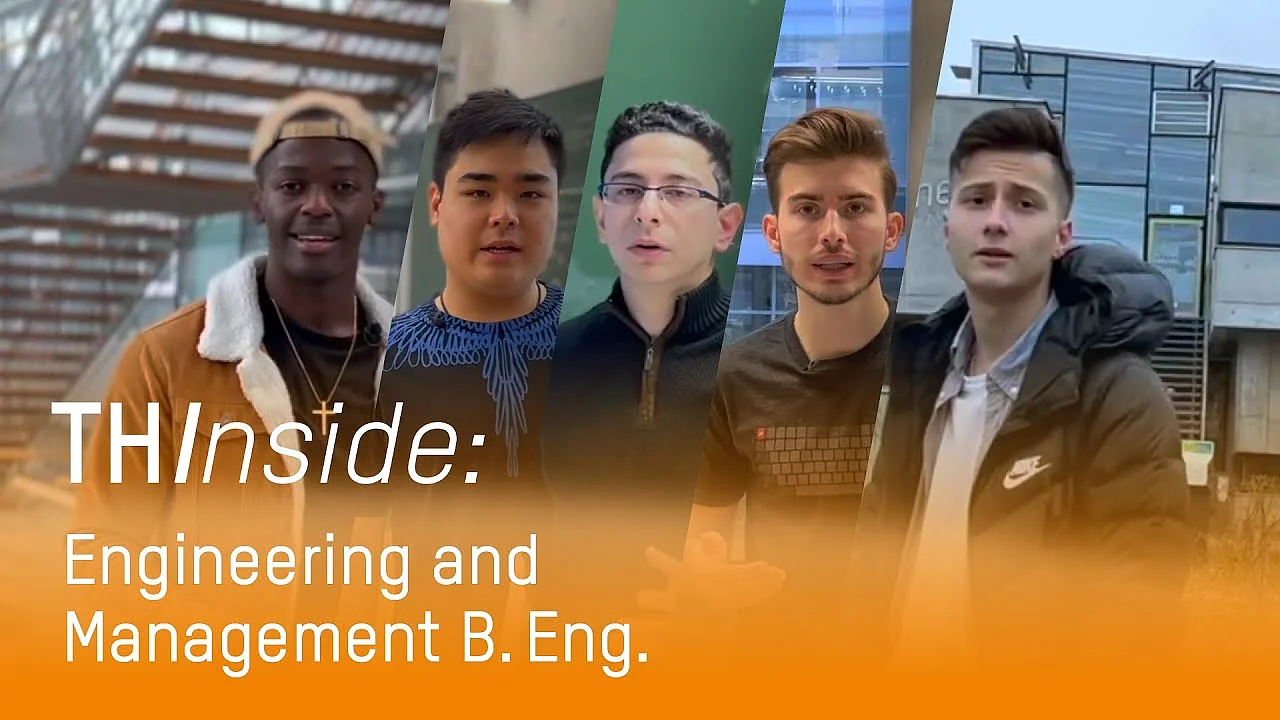
Engineering and Management Video "Made by Students"

Interesting Facts

  1. Dual study programme

    A combined model (degree programme & vocational training) OR a degree programme with in-depth practical experience (degree programme and intensive practical placements) are available. For the dual study programme, you must apply both to the company and to the university (please note: be sure to check the company’s application deadlines!). 

    More info on our dual studies-pages, or check dual cooperation partner companies. Even if no partner company is currently active in this degree programme, you are welcome to contact us.

  2. Full-time international students at THI

    From the moment you’re admitted to your degree programme right through to the end of your studies, we’ll be there to support you with a wide range of services and resources, from language courses and induction events to information on finding accommodation and questions about life in Germany. 

  3. Funding for Studies

    At THI, students have access to a wide range of support options in the form of scholarships. We recommend that students living on their own budget for at least 700–900 EUR per month for personal expenses (accommodation, health insurance, food, books, tuition fees). 

  4. Important notice on application agencies

    THI does not work with agencies. Please apply directly to THI via the uni-assist application portal for international applicants. THI never asks for money via agencies for application purposes and only sends emails from @thi.de. THI will never ask for money before you receive your letter of admission. If you require a VPD from uni-assist, you must pay a processing fee to uni-assist. However, uni-assist only checks certain documents and does not grant admission to THI. 

  5. Language skills

    • English: The program is taught entirely in English language (exception: courses of semesters 1 and 2 may also be attended in German). Sufficient language skills are essential to successfully complete the coursework. Note that we do not require English proficiency tests such as TOEFL or IELTS.
    • German: There is no requirement to formally prove German language skills for your admission. You may start with little or no German language proficiency. However, German is the official national language in Germany. The transition from your home country to the German university system and every day life will be made easier the more German you know. Furthermore, German skills will greatly increase your chances in finding a student job and or an internship at a German company.

Application period for the winter semester is May 2nd to July 15th.

Please consider that the online application is only possible in this space of time. Applications that reach the university later than that cannot be taken into consideration.

Please find further information on application for bachelor study courses.  

Dubious Application Agencies

Currently, THI is receiving an increasing amount of information regarding fraudulent activities in connection with student applications to THI. Therefore, it is important for you to know the following:

  1. THI does not work with agencies. Please apply directly to THI via the Primuss application portal.
  2. THI never asks for money via agencies for application purposes.
  3. THI only sends emails from @thi.de.
  4. THI never asks for money before you receive your admission letter. If you need a VPD from uni-assist, you will have to pay a processing fee to uni-assist. However, uni-assist only checks certain documents and does not grant admission to THI.
  5. The application process is conducted in the THI Primuss portal. Only there will you be able to access your application progress.

Important Information for Applicants from Third Countries

Please take note of our Statutes for International Orientation and Selection Procedures

For applicants from third countries, the selection process includes an assessment based on the application documents submitted. Relevant selection criteria include the grade point average of your bachelor's degree, your curriculum, your practical experience, a work sample, and an internal test. In the second stage, a selection interview is conducted.


Questions

Any questions?

Do you have any questions about applications, admission, enrolment, student finance, accommodation or other general topics? If so, please use our contact form and select the relevant topic. This will ensure your enquiry is sent directly to the relevant contact person(s) and can be answered quickly and effectively.

People

Programme Director

Jump to the top of the page