
Automated Driving and Vehicle Safety
Master of Engineering (M. Eng.)
How can you help shape the safe mobility of tomorrow?
Autonomous driving is fundamentally transforming mobility, and safety is a key enabler in this context. On the Master’s programme in Automated Driving and Vehicle Safety at THI, you will become an architect of intelligent mobility solutions. Here, you will learn to develop systems for safe automated driving that precisely map their surroundings using sensor technology, transform data into intelligent decisions and navigate safely. To this end, you will acquire the necessary tools from the fields of engineering and computer science to actively shape the mobility transition.
Automated Driving and Vehicle Safety
The Master’s programme in Automated Driving and Vehicle Safety at THI provides you with excellent qualifications for the development of automated and safe driving systems.
During the first two semesters, you will gain an in-depth understanding of the components affected by automated driving: sensor technology, propulsion, braking, steering, as well as connectivity both inside and outside the vehicle. In addition, you will acquire knowledge of machine learning and integral vehicle safety. A key aspect of the Master’s programme is also learning methods for designing a system architecture or a functional safety concept, as well as methods for test concepts and the execution of tests and simulations. Finally, in the third semester, you will write your Master’s thesis, which you may also complete whilst working in a company.
With your Master’s degree, you will be qualified for challenging roles in the research and development of algorithms, safety concepts or sensor/actuator systems for safe automated driving. You will also have the option of pursuing a PhD or a career in academia.
Curriculum Automated Driving and Vehicle Safety
1st Semester
Vehicle Actuators
Car2x-Communication
Knowledge Modeling and Machine Learning
Seminar on the fundamentals of driver assistance and active safety systems
Ethics and Law
Environmental Sensors
Elective 1
System Architectures and their Development
Simulation and Test of Functions of Automated Driving
Software Development for Automated Driving Functions
Integral Safety
Group Project
Elective 2
Master's Thesis
| 1. Semester | |
|---|---|
| 2. Semester | |
| 3. Semester |
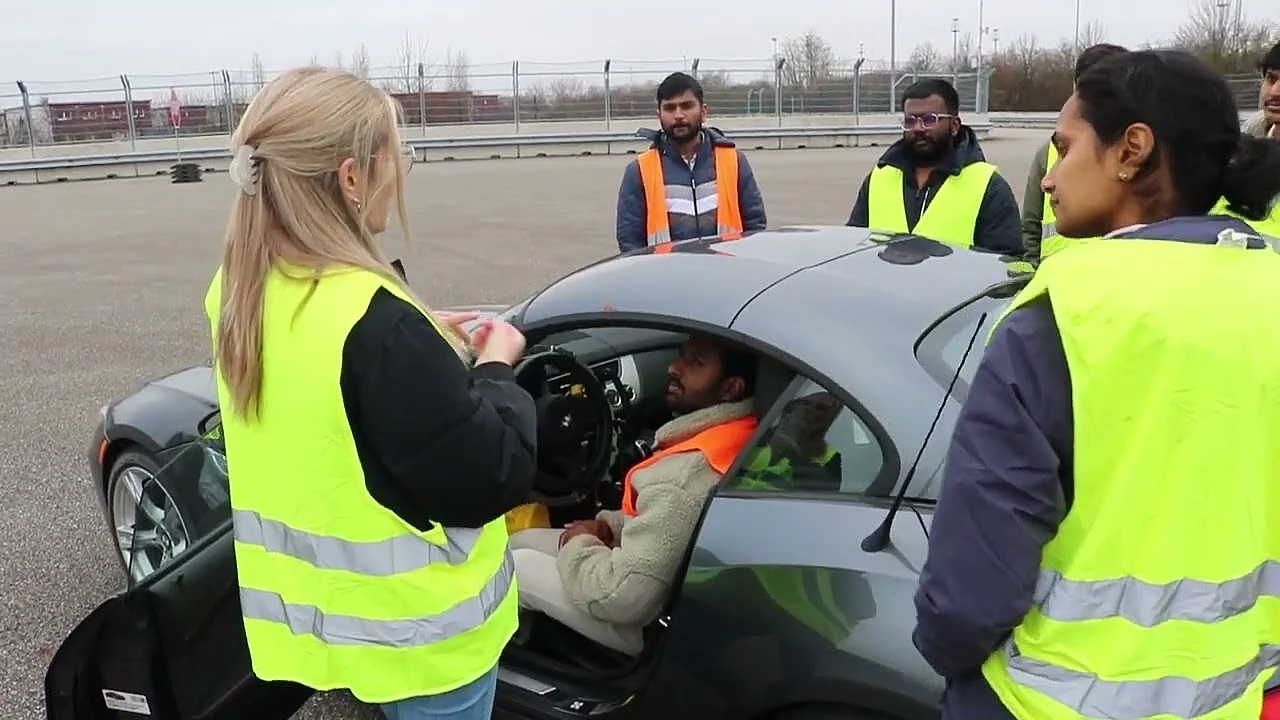
Automated driving tests at CARISSMA
Admission
The prerequisite for admission to the Master's programme is a degree in engineering science, computer science or a related field with at least 210 ECTS credits.
Qualified applicants are subject to a suitability procedure in which an overall grade is determined for the ranking of the admission procedure, consisting of
- the final grade of the Bachelor's programme with weight 0.6
- a grade with a weight of 0.4, with which a subject-specific suitability, independent scientific work and experience in the field of the design of mechatronic systems is evaluated and determined on the basis of the following criteria:
- Knowledge in the areas of automotive engineering, control engineering, signal processing, sensors / actuators, modeling and simulation of mechatronic systems, electronics, microcomputer technology, programming, methods of artificial intelligence
- Practical experience (comparable to a practical semester) in the field of designing or testing mechatronic systems including their software development
- Project work in the Bachelor's programme with a thematic reference to the vehicle or methods of vehicle automation, which required knowledge of the areas design of mechatronic vehicle components, control engineering, electronics, modeling / simulation, control devices and their programming, methods of artificial intelligence.
The aptitude is considered to have been determined if the aptitude test is rated at least with the overall grade "good" (2.5).
Programme Documents
Any questions?
Do you have any questions about applications, admission, enrolment, student finance, accommodation or other general topics? If so, please use our contact form and select the relevant topic. This will ensure your enquiry is sent directly to the relevant contact person(s) and can be answered quickly and effectively.
Contact only for content-related questions:
-
Prof. Dr.-Ing. Michael Botsch
Scientific director AImotion Bavaria; Programme director and Academic Advisor "Automated Driving and Vehicle Safety" (Master)


Other programmes you may be interested in
-
![[Translate to English:]](data:image/svg+xml;base64,PHN2ZyB4bWxucz0iaHR0cDovL3d3dy53My5vcmcvMjAwMC9zdmciIHdpZHRoPSI2MDAiIGhlaWdodD0iNDAwIi8+ "[Translate to English:]")
Electrical Engineering and Electric Mobility
Bachelor of Engineering (B. Eng.)
At the core of Electrical Engineering and Electric Mobility are electric drives, battery systems, power electronics and charging infrastructure. The curriculum connects energy storage, thermal management and vehicle integration. Particular emphasis is placed on end-to-end engineering of electrified vehicles and mobility systems.
About the degree program -
Automotive Engineering
Master of Engineering (M. Eng.)
The Master of Automotive Engineering offers in-depth training in the development of future-oriented motor vehicles with a focus on powertrains, bodywork and mechatronic systems.
About the degree program -
AI Engineering of Autonomous Systems
Master of Engineering (M. Eng.)
Discover the transformative potential of autonomous systems and how they are reshaping industries from mobility, transportation and logistics to healthcare and agriculture using artificial intelligence techniques. Join us at TH Ingolstadt, one of the leading Universities of Applied Science in Germany, and explore the design, applications, benefits, and future impact of these cutting-edge technologies.
About the degree program -
Intelligent Aerial Systems
Master of Engineering (M. Eng.)
Key areas in Intelligent Aerial Systems include aeronautics, autonomous systems, sensor technology and artificial intelligence. The programme brings together navigation, flight control and intelligent mission planning. The result is the integration of smart functionality into unmanned aerial systems.
About the degree program
![[Translate to English:]](/fileadmin/_processed_/image-enhancer/53086/ROBOCAR_Haende-1379x919-crop-default-10-112-1379-776.webp "[Translate to English:]")


