
Automotive Production Engineering & Artificial Intelligence
Automotive Production Engineering & Artificial Intelligence
- Empower engineers to master programming and AI → Learn to design and successfully execute AI projects
- Practice-first approach to learning → Up to 80% hands-on experience
The "Automotive and Production Engineering & AI" degree program provides comprehensive specialist knowledge in production and artificial intelligence, two key skills for a successful career in the automotive industry. In an industry that is investing heavily in new technologies, well-trained specialists are in high demand. In addition, the automotive industry is a global market in which international communication and cooperation are crucial. The English-language degree program provides the ideal basis for acquiring these skills and positioning yourself optimally for global competition.
What makes this program different
- Master AI & Programming: Learn with real industry tools, not just theory
- Real Projects from Day One: Work on automation, data & AI use cases
- Up to 80% Hands-On Learning: Practice-first approach with real implementation
- Engineering meets AI: Apply AI directly in production & engineering
- Learn by Building: Projects, case studies & self-driven development
Technologies You Will Work With
- AI & Machine Learning: Python, Anaconda, Jupyter Notebook, ML libraries (e.g. scikit-learn, TensorFlow, Keras) & gen AI: ChatGPT, Claude, Gemini
- Automation & Workflows: Power Automate, UiPath, Make, n8n, APIs, RPA
- Data Engineering: SQL, PostgreSQL, Orchestration tools (e.g. AirFlow), Containerization (e.g. Docker)
Curriculum Automotive Production Engineering & Artificial Intelligence
1st Semester
Credit Transfer based on work experience
Click on the course title for more information
Modern Manufacturing Technologies
<p>This module covers modern manufacturing technologies such as additive manufacturing, laser technology, and fiber-reinforced plastics. In addition, Python is used to generate CNC machine tool data for simulation purposes in predictive maintenance.</p> <p>Software used:</p> <ul><li>AI-assisted programming with Python & Power Automate</li></ul>
Data Science & AI
<p>This module covers the fundamentals of artificial intelligence and data science, as well as key application areas such as conversational and generative AI. It also addresses automated machine learning, business applications, and ethical and legal considerations.</p> <p>Software used:</p> <ul><li>AI application development platforms (e.g., IBM Watsonx portfolio)</li><li>General-purpose AI (e.g., ChatGPT, Claude, Gemini)</li></ul>
Scientific Seminar
<p>This module promotes independent and methodical academic work on current topics in production and digitization. Students work in small groups of two to three.</p> <p>Software used:</p> <ul><li>Select any digital technology or software for evaluation</li></ul>
Digital Factory & Digital Eng.
<p>This module provides an introduction to artificial intelligence and an overview of software applications in industry. It focuses on the evaluation of digital technologies and the practical implementation of automation solutions using low-code and RPA.</p> <p>Software used for practical projects:</p> <ul><li>Make or</li><li>Power Automate or</li><li>UiPath or</li><li>N8N</li></ul>
Production System & Plant Design
<p>This module covers the fundamentals of production systems, process-oriented approaches, and lean manufacturing. It also addresses machine tools, capacity planning, and methods such as MTM and REFA, as well as Design for Manufacturing and Assembly.</p> <p>Software used:</p> <ul><li>Halocline VR Planning, Assistant</li></ul>
Data Science & AI II
<p>This module delves into machine learning approaches, including classical and deep learning methods, and covers the data science workflow. It also addresses the customization of large language models (LLMs), such as through retrieval-augmented generation, as well as the development and prototyping of use cases. Additionally, the module distinguishes between predictive and causal data analysis.</p> <p>Software used:</p> <ul><li>Anaconda, Python, Jupyter Notebook, ML libraries (e.g., scikit-learn, TensorFlow, Keras) </li><li>Coding assistants</li><li>AI Application Development Platforms</li></ul>
Automation & Equipment
<p>This module covers fundamentals of automation and equipment engineering, including PLC programming in industrial manufacturing, an overview of robotics applications, robot types and kinematics, and basics of vectors and matrices. It also addresses robot programming methods (online/offline) and fundamentals of robotic perception, including CNN-based visual data processing.</p> <p>Software used:</p> <ul><li>Automation Software Automation: Siemens TIA Portal, Factory IO</li><li>Robot Software: Polyscope (Universal Robots), Phyton</li><li>Robot Control: KUKA KRC4</li></ul>
Data Engineering & Databases
<p>This module covers the fundamentals of big data as well as various data types and structures. Topics include relational and NoSQL database systems, optimized storage formats, distributed file systems, and computing frameworks.</p> <p>Software used:</p> <ul><li>SQL, Python</li><li>Databases (e.g., Postgres)</li><li>Orchestration tools (e.g., AirFlow)</li><li>Containerization (e.g., Docker)</li></ul>
Engineering Processes in Automotive Industry
<p>This module addresses engineering processes in the automotive industry, including product and process development, requirements and quality management methods, and pre-series processes and systems engineering. It also covers modeling with SysML and SPICE for assessing process capability, maturity levels, and performance indicators.</p> <p>Software used:</p> <ul><li>Engineering: Cameo or CATIA Magic</li><li>SPICE: Polarion, DOORS, Tessy, etc.</li></ul>
Master Thesis
<p>The master's thesis teaches students how to conduct independent academic research, from defining the problem and conducting research to selecting methods, analyzing data, and presenting results. The focus is on a systematic approach, logical reasoning, and goal-oriented work.</p> <p>Software used:</p> <ul><li>Select any digital technology or software for evaluation or application</li></ul>
| 1. Semester | |
|---|---|
| 1. Semester | |
| 2. Semester | |
| 3. Semester | |
| 4. Semester | |
| 5. Semester |
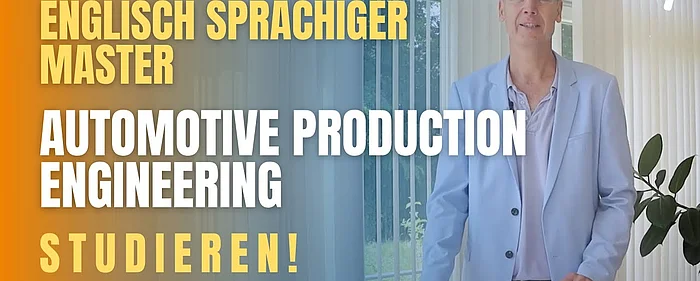
3 Questions for Our Program Director, Prof. Axmann
a) Proof of successful completion of a degree program in engineering, natural sciences, technology or business administration, or
computer science program at a German university with at least 210 ECTS credit points or an equivalent level of study or an equivalent
successful domestic or foreign degree,
b) proof of at least one year of relevantly qualified practical professional experience after completing the university degree or equivalent qualification referred to in a); relevantly qualified practical professional experience is particularly in the areas of product or technology development, information technology (IT) in general, enterprise resource planning (ERP), Industry 4.0, Internet of Things (IoT) or manufacturing execution system (MES); project work in the area of "digitization of the company" is also considered relevantly qualified practical professional experience and
c) proof of sufficient knowledge of the English language (language level B2 of the Common European Framework of Reference for Languages)
Any questions?
Do you have any questions about applications, admission, enrolment, student finance, accommodation or other general topics? If so, please use our contact form and select the relevant topic. This will ensure your enquiry is sent directly to the relevant contact person(s) and can be answered quickly and effectively.
Programme Director
-
Prof. Dr. Bernhard Axmann
Programme director, Academic advisor Automotive Production Engineering (Master)


Programm-Manager for interested parties
-
Andrea Schiberna

Other programmes you may be interested in
-

Automotive Production Engineering
Master of Engineering (M. Eng.)
Automotive Production Engineering focuses on automotive manufacturing, factory planning, automation and production systems. The curriculum connects connected equipment, process optimisation and AI-enabled operations. The result is efficient, flexible and data-driven production environments. The programme combines rigorous analysis with application-oriented subject knowledge.
About the degree program -
Automotive Engineering & Technology
Master of Engineering (M. Eng.)
The mobility of tomorrow is born where innovative technologies meet sound engineering. In the Master’s program in Automotive Engineering & Technology, you’ll explore modern vehicle concepts, connected systems, and cutting-edge developments in the automotive industry.
About the degree program -
Applied artificial intelligence
Master of Science (M. Sc.)
Shape the intelligent technologies of tomorrow: The Applied Artificial Intelligence master's program provides advanced expertise in machine learning, data science, and AI applications. Work on real-world challenges and prepare for demanding roles in industry, research, and development.
About the degree program -
Mobility and innovation management
Master of Business Administration (MBA)
New mobility concepts, digital technologies and innovative services are fundamentally transforming the industry. The MBA in Mobility and Innovation Management combines management expertise with forward-looking mobility topics and prepares you for leadership roles in a dynamic innovation environment.
About the degree program


Automotive Production Engineering & Artificial Intelligence
- Empower engineers to master programming and AI → Learn to design and successfully execute AI projects
- Practice-first approach to learning → Up to 80% hands-on experience
The "Automotive and Production Engineering & AI" degree program provides comprehensive specialist knowledge in production and artificial intelligence, two key skills for a successful career in the automotive industry. In an industry that is investing heavily in new technologies, well-trained specialists are in high demand. In addition, the automotive industry is a global market in which international communication and cooperation are crucial. The English-language degree program provides the ideal basis for acquiring these skills and positioning yourself optimally for global competition.
What makes this program different
- Master AI & Programming: Learn with real industry tools, not just theory
- Real Projects from Day One: Work on automation, data & AI use cases
- Up to 80% Hands-On Learning: Practice-first approach with real implementation
- Engineering meets AI: Apply AI directly in production & engineering
- Learn by Building: Projects, case studies & self-driven development
Technologies You Will Work With
- AI & Machine Learning: Python, Anaconda, Jupyter Notebook, ML libraries (e.g. scikit-learn, TensorFlow, Keras) & gen AI: ChatGPT, Claude, Gemini
- Automation & Workflows: Power Automate, UiPath, Make, n8n, APIs, RPA
- Data Engineering: SQL, PostgreSQL, Orchestration tools (e.g. AirFlow), Containerization (e.g. Docker)
Curriculum Automotive Production Engineering & Artificial Intelligence
1st Semester
Credit Transfer based on work experience
Click on the course title for more information
Modern Manufacturing Technologies
<p>This module covers modern manufacturing technologies such as additive manufacturing, laser technology, and fiber-reinforced plastics. In addition, Python is used to generate CNC machine tool data for simulation purposes in predictive maintenance.</p> <p>Software used:</p> <ul><li>AI-assisted programming with Python & Power Automate</li></ul>
Data Science & AI
<p>This module covers the fundamentals of artificial intelligence and data science, as well as key application areas such as conversational and generative AI. It also addresses automated machine learning, business applications, and ethical and legal considerations.</p> <p>Software used:</p> <ul><li>AI application development platforms (e.g., IBM Watsonx portfolio)</li><li>General-purpose AI (e.g., ChatGPT, Claude, Gemini)</li></ul>
Scientific Seminar
<p>This module promotes independent and methodical academic work on current topics in production and digitization. Students work in small groups of two to three.</p> <p>Software used:</p> <ul><li>Select any digital technology or software for evaluation</li></ul>
Digital Factory & Digital Eng.
<p>This module provides an introduction to artificial intelligence and an overview of software applications in industry. It focuses on the evaluation of digital technologies and the practical implementation of automation solutions using low-code and RPA.</p> <p>Software used for practical projects:</p> <ul><li>Make or</li><li>Power Automate or</li><li>UiPath or</li><li>N8N</li></ul>
Production System & Plant Design
<p>This module covers the fundamentals of production systems, process-oriented approaches, and lean manufacturing. It also addresses machine tools, capacity planning, and methods such as MTM and REFA, as well as Design for Manufacturing and Assembly.</p> <p>Software used:</p> <ul><li>Halocline VR Planning, Assistant</li></ul>
Data Science & AI II
<p>This module delves into machine learning approaches, including classical and deep learning methods, and covers the data science workflow. It also addresses the customization of large language models (LLMs), such as through retrieval-augmented generation, as well as the development and prototyping of use cases. Additionally, the module distinguishes between predictive and causal data analysis.</p> <p>Software used:</p> <ul><li>Anaconda, Python, Jupyter Notebook, ML libraries (e.g., scikit-learn, TensorFlow, Keras) </li><li>Coding assistants</li><li>AI Application Development Platforms</li></ul>
Automation & Equipment
<p>This module covers fundamentals of automation and equipment engineering, including PLC programming in industrial manufacturing, an overview of robotics applications, robot types and kinematics, and basics of vectors and matrices. It also addresses robot programming methods (online/offline) and fundamentals of robotic perception, including CNN-based visual data processing.</p> <p>Software used:</p> <ul><li>Automation Software Automation: Siemens TIA Portal, Factory IO</li><li>Robot Software: Polyscope (Universal Robots), Phyton</li><li>Robot Control: KUKA KRC4</li></ul>
Data Engineering & Databases
<p>This module covers the fundamentals of big data as well as various data types and structures. Topics include relational and NoSQL database systems, optimized storage formats, distributed file systems, and computing frameworks.</p> <p>Software used:</p> <ul><li>SQL, Python</li><li>Databases (e.g., Postgres)</li><li>Orchestration tools (e.g., AirFlow)</li><li>Containerization (e.g., Docker)</li></ul>
Engineering Processes in Automotive Industry
<p>This module addresses engineering processes in the automotive industry, including product and process development, requirements and quality management methods, and pre-series processes and systems engineering. It also covers modeling with SysML and SPICE for assessing process capability, maturity levels, and performance indicators.</p> <p>Software used:</p> <ul><li>Engineering: Cameo or CATIA Magic</li><li>SPICE: Polarion, DOORS, Tessy, etc.</li></ul>
Master Thesis
<p>The master's thesis teaches students how to conduct independent academic research, from defining the problem and conducting research to selecting methods, analyzing data, and presenting results. The focus is on a systematic approach, logical reasoning, and goal-oriented work.</p> <p>Software used:</p> <ul><li>Select any digital technology or software for evaluation or application</li></ul>
| 1. Semester | |
|---|---|
| 1. Semester | |
| 2. Semester | |
| 3. Semester | |
| 4. Semester | |
| 5. Semester |
3 Questions for Our Program Director, Prof. Axmann
a) Proof of successful completion of a degree program in engineering, natural sciences, technology or business administration, or
computer science program at a German university with at least 210 ECTS credit points or an equivalent level of study or an equivalent
successful domestic or foreign degree,
b) proof of at least one year of relevantly qualified practical professional experience after completing the university degree or equivalent qualification referred to in a); relevantly qualified practical professional experience is particularly in the areas of product or technology development, information technology (IT) in general, enterprise resource planning (ERP), Industry 4.0, Internet of Things (IoT) or manufacturing execution system (MES); project work in the area of "digitization of the company" is also considered relevantly qualified practical professional experience and
c) proof of sufficient knowledge of the English language (language level B2 of the Common European Framework of Reference for Languages)
Any questions?
Do you have any questions about applications, admission, enrolment, student finance, accommodation or other general topics? If so, please use our contact form and select the relevant topic. This will ensure your enquiry is sent directly to the relevant contact person(s) and can be answered quickly and effectively.
Programme Director
-
Prof. Dr. Bernhard Axmann
Programme director, Academic advisor Automotive Production Engineering (Master)
Programm-Manager for interested parties
-
Andrea Schiberna
Other programmes you may be interested in
-
Automotive Production Engineering
Master of Engineering (M. Eng.)
Automotive Production Engineering focuses on automotive manufacturing, factory planning, automation and production systems. The curriculum connects connected equipment, process optimisation and AI-enabled operations. The result is efficient, flexible and data-driven production environments. The programme combines rigorous analysis with application-oriented subject knowledge.
About the degree program -
Automotive Engineering & Technology
Master of Engineering (M. Eng.)
The mobility of tomorrow is born where innovative technologies meet sound engineering. In the Master’s program in Automotive Engineering & Technology, you’ll explore modern vehicle concepts, connected systems, and cutting-edge developments in the automotive industry.
About the degree program -
Applied artificial intelligence
Master of Science (M. Sc.)
Shape the intelligent technologies of tomorrow: The Applied Artificial Intelligence master's program provides advanced expertise in machine learning, data science, and AI applications. Work on real-world challenges and prepare for demanding roles in industry, research, and development.
About the degree program -
Mobility and innovation management
Master of Business Administration (MBA)
New mobility concepts, digital technologies and innovative services are fundamentally transforming the industry. The MBA in Mobility and Innovation Management combines management expertise with forward-looking mobility topics and prepares you for leadership roles in a dynamic innovation environment.
About the degree program