Engineering Mathematics 1
Provides mathematical foundations for engineering, including functions, differential and integral calculus, complex numbers, and differential equations for solving engineering problems.

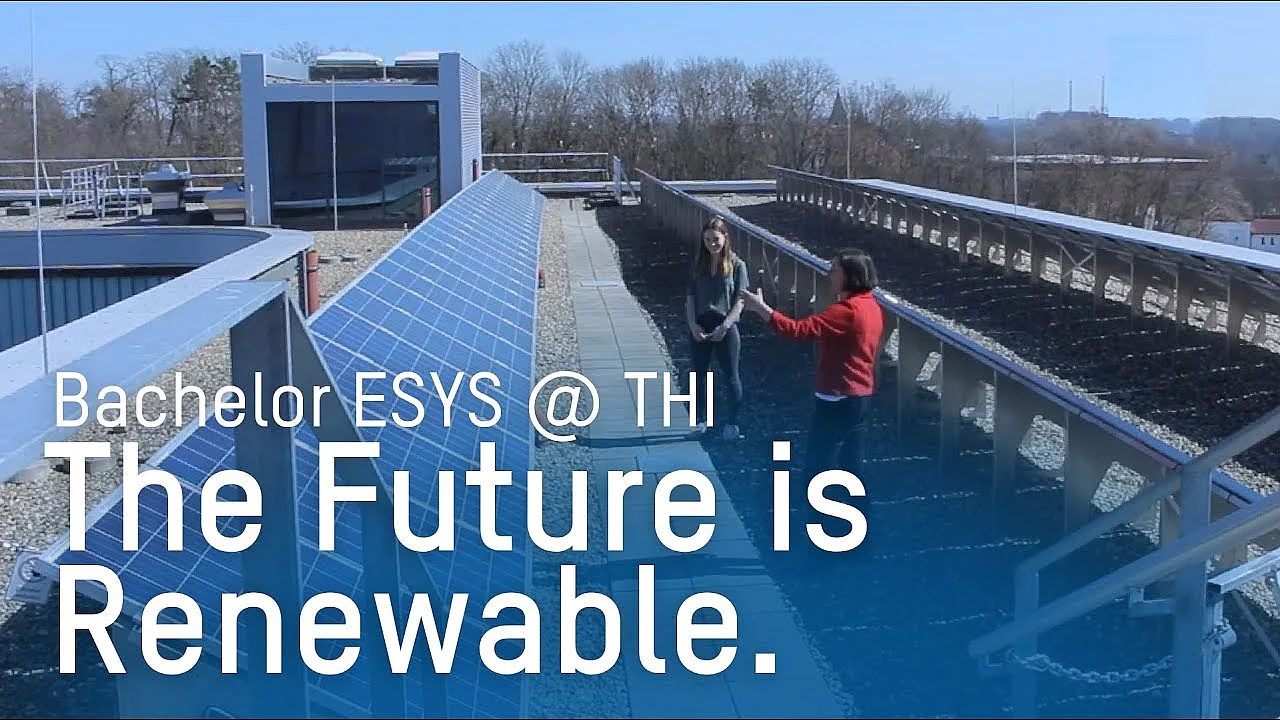
Starte deine Zukunft im internationalen Bachelor Energy Systems and Renewable Energies an der THI. Dieser Bachelor ist komplett auf Englisch und perfekt für dich, wenn du dich für Energietechnik und Nachhaltigkeit auf Basis von Maschinenbau- und Elektrotechnik-Grundlagen interessierst.
Hier erfährst du, wie klimafreundliche Stromerzeugung funktioniert, wie intelligente Netze Energie effizient verteilen und warum smarte Speicherlösungen die Energiewende voranbringen. Zusätzlich beschäftigst du dich mit modernen Methoden der Digitalisierung wie Künstlicher Intelligenz in der Energietechnik, etwa zur Prognose, Optimierung und intelligenten Regelung von Energiesystemen. Mithilfe von Digital Twins modellierst und simulierst du reale Anlagen und Netze virtuell, um Betrieb, Planung und Wartung effizienter und nachhaltiger zu gestalten. Außerdem lernst du alles zur Interaktion mit neuen Arten von Prosumern (Produzenten/Konsumenten), gerade in den Bereichen Elektromobilität und Power-to-Heat. Gemeinsam mit internationalen Kommilitonen arbeitest du an realen Herausforderungen, sammelst interkulturelle Erfahrungen und wertvolle Kontakte zu Unternehmen in der Branche. Auch ein Auslandssemester darfst du sehr gerne einplanen!
Unser internationaler Bachelor-Studiengang Energy Systems and Renewable Energies in englischer Sprache richtet sich an ausländische und deutsche Studierende, die sich für Energietechnik und Nachhaltigkeit auf der Basis der Grundlagen des Maschinenbaus und der Elektrotechnik interessieren. Hier geht's zum deutschsprachigen “Energiesysteme und Erneuerbare Energien”
Das Studium eröffnet vielfältige Karriereperspektiven in der Energietechnik und bereitet auf anspruchsvolle Fach- und Führungsaufgaben vor. Durch die praxisnahe Ausbildung und den engen Bezug zur Branche erwerben Absolventinnen und Absolventen umfassende Kompetenzen für die Gestaltung zukünftiger Energiesysteme. Typische Tätigkeitsfelder liegen in der nachhaltigen Energieerzeugung und -verteilung, der Entwicklung, Produktion und dem Betrieb energietechnischer Anlagen und Systeme sowie in der Planung von Energiesystemen und der Energieberatung. Internationale Erfahrungen während des Studiums erweitern die beruflichen Perspektiven zusätzlich.
→ Online Bachelor-Talk für Studieninteressierte am 10.11.2026 um 16.00 Uhr.
<figure class="table" style="width:411pt;"><table><tbody><tr><td style="height:28.5pt;width:411pt;">Provides mathematical foundations for engineering, including functions, differential and integral calculus, complex numbers, and differential equations for solving engineering problems.</td></tr></tbody></table></figure>
<figure class="table" style="width:411pt;"><table><tbody><tr><td style="height:28.5pt;width:411pt;">Introduction to algorithms, programming, and object-oriented concepts with practical exercises solving engineering problems.</td></tr></tbody></table></figure>
<figure class="table" style="width:411pt;"><table><tbody><tr><td style="height:28.5pt;width:411pt;">Fundamentals of technical drawing and mechanical design focusing on standards, tolerances, machine elements, and design rules.</td></tr></tbody></table></figure>
<figure class="table" style="width:411pt;"><table><tbody><tr><td style="height:28.5pt;width:411pt;">Covers forces, moments, support reactions, trusses, and friction as foundations of static system analysis.</td></tr></tbody></table></figure>
<figure class="table" style="width:411pt;"><table><tbody><tr><td style="height:28.5pt;width:411pt;">Introduction to DC and AC circuits, electric fields, semiconductor devices, and measurement techniques.</td></tr></tbody></table></figure>
<figure class="table" style="width:411pt;"><table><tbody><tr><td style="height:28.5pt;width:411pt;">Introduces current and future energy systems, policy frameworks, markets, and economic evaluation methods.</td></tr></tbody></table></figure>
<figure class="table" style="width:411pt;"><table><tbody><tr><td style="height:28.5pt;width:411pt;">Building on Mathematics 1, the course covers matrices, series, eigenvalues, and multivariable calculus for advanced engineering modeling.</td></tr></tbody></table></figure>
<figure class="table" style="width:411pt;"><table><tbody><tr><td style="height:28.5pt;width:411pt;">Covers atomic structures, crystal lattices, deformation mechanisms, diffusion, phase diagrams, and basics of material testing.</td></tr></tbody></table></figure>
<figure class="table" style="width:411pt;"><table><tbody><tr><td style="height:28.5pt;width:411pt;">Analysis of stress, strain, and deformation under various load cases and component design.</td></tr></tbody></table></figure>
<figure class="table" style="width:411pt;"><table><tbody><tr><td style="height:28.5pt;width:411pt;">Fundamentals of thermodynamics including state variables, laws, cycles, and phase changes.</td></tr></tbody></table></figure>
<figure class="table" style="width:411pt;"><table><tbody><tr><td style="height:28.5pt;width:411pt;">Overview of thermal, electrical, chemical, and mechanical energy storage systems and their design and evaluation.</td></tr></tbody></table></figure>
<figure class="table" style="width:411pt;"><table><tbody><tr><td style="height:28.5pt;width:411pt;">Addresses sustainability, business models, innovation, and development of sustainable products and start-ups.</td></tr></tbody></table></figure>
<p>This module introduces systematic product development methods and the use of 3D CAD. Topics include requirement analysis, concept development, and technical design. Students also learn modeling, assembly design, and the creation of standard-compliant drawings using CATIA.</p>
<figure class="table" style="width:411pt;"><table><tbody><tr><td style="height:28.5pt;width:411pt;">Basics of measurement engineering, sensors, measurement errors, uncertainty analysis, temperature and flow measurement.</td></tr></tbody></table></figure>
<figure class="table" style="width:411pt;"><table><tbody><tr><td style="height:76.0pt;width:411pt;">This module covers design and calculation of key machine elements such as screws, shafts, bearings, gears, and clutches. Topics include strength, loads, lifetime, and connection methods, as well as sealing and lubrication. The focus is on selecting, dimensioning, and integrating components into complete engineering designs.</td></tr></tbody></table></figure>
<figure class="table" style="width:411pt;"><table><tbody><tr><td style="height:28.5pt;width:411pt;">Advanced heat transfer by conduction, convection, and radiation including heat exchanger design and lab work.</td></tr></tbody></table></figure>
<figure class="table" style="width:411pt;"><table><tbody><tr><td style="height:28.5pt;width:411pt;">Covers fluid flow of liquids and gases, conservation equations, pressure losses, and laboratory experiments.</td></tr></tbody></table></figure>
<figure class="table" style="width:411pt;"><table><tbody><tr><td style="height:77.0pt;width:411pt;">This module provides an overview of thermal energy systems and power plants. It covers energy conversion, combustion, fluid machinery, and steam, gas, and combustion engine processes. It also includes modern technologies such as fuel cells, heat pumps, and refrigeration systems, along with their design and simulation.</td></tr></tbody></table></figure>
<figure class="table" style="width:411pt;"><table><tbody><tr><td style="height:28.5pt;width:411pt;">Team-based development and design project with practical engineering tasks.</td></tr></tbody></table></figure>
<figure class="table" style="width:411pt;"><table><tbody><tr><td style="height:28.5pt;width:411pt;">Introduction to control loops, modeling, stability analysis, controller design, and simulation.</td></tr></tbody></table></figure>
<figure class="table" style="width:411pt;"><table><tbody><tr><td style="height:28.5pt;width:411pt;">Focus on CHP technologies, heat networks, gas and electricity grids, and hydrogen integration.</td></tr></tbody></table></figure>
<figure class="table" style="width:411pt;"><table><tbody><tr><td style="height:28.5pt;width:411pt;">Energy-efficient buildings, HVAC systems, and smart home concepts.</td></tr></tbody></table></figure>
<figure class="table" style="width:411pt;"><table><tbody><tr><td style="height:28.5pt;width:411pt;">Solar thermal and photovoltaic systems: components, simulation, planning, and efficiency evaluation.</td></tr></tbody></table></figure>
<figure class="table" style="width:411pt;"><table><tbody><tr><td style="height:28.5pt;width:411pt;">Covers cost accounting, investment evaluation, and integration of sustainability criteria.</td></tr></tbody></table></figure>
<figure class="table" style="width:411pt;"><table><tbody><tr><td style="height:28.5pt;width:411pt;">Develops key skills such as presentation, teamwork, and conflict management.</td></tr></tbody></table></figure>
<figure class="table" style="width:411pt;"><table><tbody><tr><td style="height:58.0pt;width:411pt;">The module involves practical training in a company related to energy technology and renewable energies. It includes working on real engineering tasks, gaining insight into operational processes, and applying and deepening previously acquired technical and methodological skills.</td></tr></tbody></table></figure>
<figure class="table" style="width:411pt;"><table><tbody><tr><td style="height:28.5pt;width:411pt;">Project and quality management methods including planning, risk analysis, and standards.</td></tr></tbody></table></figure>
<figure class="table" style="width:411pt;"><table><tbody><tr><td style="height:28.5pt;width:411pt;">Independent interdisciplinary project with technical and economic focus.</td></tr></tbody></table></figure>
<figure class="table" style="width:418pt;"><table><tbody><tr><td style="height:29.0pt;width:418pt;">The compulsory elective modules in the specialist subject area can be chosen according to your field of study and personal interests.</td></tr></tbody></table></figure>
<figure class="table" style="width:418pt;"><table><tbody><tr><td style="height:29.0pt;width:418pt;">The compulsory elective modules in the specialist subject area can be chosen according to your field of study and personal interests.</td></tr></tbody></table></figure>
<figure class="table" style="width:411pt;"><table><tbody><tr><td style="height:28.5pt;width:411pt;">Energy consulting, building refurbishment, simulation, and advanced building concepts.</td></tr></tbody></table></figure>
<figure class="table" style="width:411pt;"><table><tbody><tr><td style="height:28.5pt;width:411pt;">Analysis of energy markets and sector coupling technologies including power-to-X.</td></tr></tbody></table></figure>
<figure class="table" style="width:411pt;"><table><tbody><tr><td style="height:28.5pt;width:411pt;">Smart grids, grid stability, and wind turbine analysis and design.</td></tr></tbody></table></figure>
<figure class="table" style="width:418pt;"><table><tbody><tr><td style="height:29.0pt;width:418pt;">The compulsory elective modules in the specialist subject area can be chosen according to your field of study and personal interests.</td></tr></tbody></table></figure>
<figure class="table" style="width:411pt;"><table><tbody><tr><td style="height:28.5pt;width:411pt;">Preparation for the bachelor’s thesis through scientific work and topic planning.</td></tr><tr><td style="height:28.5pt;width:411pt;">Independent work on an engineering topic, often with practical relevance.</td></tr></tbody></table></figure>
<figure class="table" style="width:411pt;"><table><tbody><tr><td style="height:28.5pt;width:411pt;">Use of biomass via combustion, gasification, fermentation, and plant design.</td></tr></tbody></table></figure>
<figure class="table" style="width:411pt;"><table><tbody><tr><td style="height:28.5pt;width:411pt;">Examines mobility, powertrains, charging infrastructure, and grid integration.</td></tr></tbody></table></figure>
| 1. Semester | |
|---|---|
| 2. Semester | |
| 3. Semester | |
| 4. Semester | |
| 5. Semester | |
| 6. Semester | |
| 7. Semester |


Wärmepumpe im Labor


Exkursion Stadtwerke München
Studienplatzbewerbung
Im Studiengang ist ein Studienbeginn zum Wintersemester möglich.
Da der Studiengang nicht zulassungsbeschränkt ist, erfolgt die Bewerbung über das PRIMUSS-Bewerberportal THI.
Voraussetzungen
Voraussetzung für die Zulassung zum Studium an der Technischen Hochschule Ingolstadt ist entweder die allgemeine oder fachgebundene Hochschulreife oder die Fachhochschulreife. Regelungen zur Vorpraxis werden in den Studien- und Prüfungsordnungen der jeweiligen Studiengänge getroffen.
Du hast Fragen zu Bewerbung, Zulassung, Einschreibung, Studienfinanzierung, Wohnen oder anderen allgemeinen Themen? Dann nutze bitte unser Kontaktformular und wähle das passende Anliegen aus. So landet deine Anfrage direkt bei den zuständigen Ansprechpartnerinnen und Ansprechpartnern und kann schnell und gezielt beantwortet werden.

Studienbotschafter Energy Systems and Renewable Energies


Master of Science (M. Sc.)
Der Master Renewable Energy Systems vermittelt die notwendigen Fähigkeiten, um Energiesysteme im internationalen Kontext erfolgreich zu planen, zu entwickeln und zu steuern.
Zum Studiengang
Bachelor of Engineering (B. Eng.)
Ingenieurwissenschaften - ein Studiengang mit zahlreichen Möglichkeiten: Nach den ersten zwei Semestern hast Du die Wahl zwischen Entwicklung & Konstruktion, Elektromobilität, Entwicklung Flugsysteme, Energietechnik oder Digital Engineering.
Zum Studiengang
Bachelor of Engineering (B. Eng.)
Umweltingenieure gestalten mit Wind- und Solarenergie, Wasserstoff und Biogas die Klimawende. Innovative, zukunftsweisende Ideen sind gefragt: Studiere nachhaltig mit maschinenbaulichen Grundlagen an der TH Ingolstadt. Unternehmen haben enormen Bedarf an Fachkräften!
Zum Studiengang
Master of Engineering (M. Eng.)
Ein einzigartiges Studienangebot in Deutschland: der Master Wasserstofftechnologie und -wirtschaft an der THI. Mobilitätswende und Klimaziele im Blick - mit Wasserstoff aus Windenergie!
Zum StudiengangStarte deine Zukunft im internationalen Bachelor Energy Systems and Renewable Energies an der THI. Dieser Bachelor ist komplett auf Englisch und perfekt für dich, wenn du dich für Energietechnik und Nachhaltigkeit auf Basis von Maschinenbau- und Elektrotechnik-Grundlagen interessierst.
Hier erfährst du, wie klimafreundliche Stromerzeugung funktioniert, wie intelligente Netze Energie effizient verteilen und warum smarte Speicherlösungen die Energiewende voranbringen. Zusätzlich beschäftigst du dich mit modernen Methoden der Digitalisierung wie Künstlicher Intelligenz in der Energietechnik, etwa zur Prognose, Optimierung und intelligenten Regelung von Energiesystemen. Mithilfe von Digital Twins modellierst und simulierst du reale Anlagen und Netze virtuell, um Betrieb, Planung und Wartung effizienter und nachhaltiger zu gestalten. Außerdem lernst du alles zur Interaktion mit neuen Arten von Prosumern (Produzenten/Konsumenten), gerade in den Bereichen Elektromobilität und Power-to-Heat. Gemeinsam mit internationalen Kommilitonen arbeitest du an realen Herausforderungen, sammelst interkulturelle Erfahrungen und wertvolle Kontakte zu Unternehmen in der Branche. Auch ein Auslandssemester darfst du sehr gerne einplanen!
Unser internationaler Bachelor-Studiengang Energy Systems and Renewable Energies in englischer Sprache richtet sich an ausländische und deutsche Studierende, die sich für Energietechnik und Nachhaltigkeit auf der Basis der Grundlagen des Maschinenbaus und der Elektrotechnik interessieren. Hier geht's zum deutschsprachigen “Energiesysteme und Erneuerbare Energien”
Das Studium eröffnet vielfältige Karriereperspektiven in der Energietechnik und bereitet auf anspruchsvolle Fach- und Führungsaufgaben vor. Durch die praxisnahe Ausbildung und den engen Bezug zur Branche erwerben Absolventinnen und Absolventen umfassende Kompetenzen für die Gestaltung zukünftiger Energiesysteme. Typische Tätigkeitsfelder liegen in der nachhaltigen Energieerzeugung und -verteilung, der Entwicklung, Produktion und dem Betrieb energietechnischer Anlagen und Systeme sowie in der Planung von Energiesystemen und der Energieberatung. Internationale Erfahrungen während des Studiums erweitern die beruflichen Perspektiven zusätzlich.
→ Online Bachelor-Talk für Studieninteressierte am 10.11.2026 um 16.00 Uhr.
<figure class="table" style="width:411pt;"><table><tbody><tr><td style="height:28.5pt;width:411pt;">Provides mathematical foundations for engineering, including functions, differential and integral calculus, complex numbers, and differential equations for solving engineering problems.</td></tr></tbody></table></figure>
<figure class="table" style="width:411pt;"><table><tbody><tr><td style="height:28.5pt;width:411pt;">Introduction to algorithms, programming, and object-oriented concepts with practical exercises solving engineering problems.</td></tr></tbody></table></figure>
<figure class="table" style="width:411pt;"><table><tbody><tr><td style="height:28.5pt;width:411pt;">Fundamentals of technical drawing and mechanical design focusing on standards, tolerances, machine elements, and design rules.</td></tr></tbody></table></figure>
<figure class="table" style="width:411pt;"><table><tbody><tr><td style="height:28.5pt;width:411pt;">Covers forces, moments, support reactions, trusses, and friction as foundations of static system analysis.</td></tr></tbody></table></figure>
<figure class="table" style="width:411pt;"><table><tbody><tr><td style="height:28.5pt;width:411pt;">Introduction to DC and AC circuits, electric fields, semiconductor devices, and measurement techniques.</td></tr></tbody></table></figure>
<figure class="table" style="width:411pt;"><table><tbody><tr><td style="height:28.5pt;width:411pt;">Introduces current and future energy systems, policy frameworks, markets, and economic evaluation methods.</td></tr></tbody></table></figure>
<figure class="table" style="width:411pt;"><table><tbody><tr><td style="height:28.5pt;width:411pt;">Building on Mathematics 1, the course covers matrices, series, eigenvalues, and multivariable calculus for advanced engineering modeling.</td></tr></tbody></table></figure>
<figure class="table" style="width:411pt;"><table><tbody><tr><td style="height:28.5pt;width:411pt;">Covers atomic structures, crystal lattices, deformation mechanisms, diffusion, phase diagrams, and basics of material testing.</td></tr></tbody></table></figure>
<figure class="table" style="width:411pt;"><table><tbody><tr><td style="height:28.5pt;width:411pt;">Analysis of stress, strain, and deformation under various load cases and component design.</td></tr></tbody></table></figure>
<figure class="table" style="width:411pt;"><table><tbody><tr><td style="height:28.5pt;width:411pt;">Fundamentals of thermodynamics including state variables, laws, cycles, and phase changes.</td></tr></tbody></table></figure>
<figure class="table" style="width:411pt;"><table><tbody><tr><td style="height:28.5pt;width:411pt;">Overview of thermal, electrical, chemical, and mechanical energy storage systems and their design and evaluation.</td></tr></tbody></table></figure>
<figure class="table" style="width:411pt;"><table><tbody><tr><td style="height:28.5pt;width:411pt;">Addresses sustainability, business models, innovation, and development of sustainable products and start-ups.</td></tr></tbody></table></figure>
<p>This module introduces systematic product development methods and the use of 3D CAD. Topics include requirement analysis, concept development, and technical design. Students also learn modeling, assembly design, and the creation of standard-compliant drawings using CATIA.</p>
<figure class="table" style="width:411pt;"><table><tbody><tr><td style="height:28.5pt;width:411pt;">Basics of measurement engineering, sensors, measurement errors, uncertainty analysis, temperature and flow measurement.</td></tr></tbody></table></figure>
<figure class="table" style="width:411pt;"><table><tbody><tr><td style="height:76.0pt;width:411pt;">This module covers design and calculation of key machine elements such as screws, shafts, bearings, gears, and clutches. Topics include strength, loads, lifetime, and connection methods, as well as sealing and lubrication. The focus is on selecting, dimensioning, and integrating components into complete engineering designs.</td></tr></tbody></table></figure>
<figure class="table" style="width:411pt;"><table><tbody><tr><td style="height:28.5pt;width:411pt;">Advanced heat transfer by conduction, convection, and radiation including heat exchanger design and lab work.</td></tr></tbody></table></figure>
<figure class="table" style="width:411pt;"><table><tbody><tr><td style="height:28.5pt;width:411pt;">Covers fluid flow of liquids and gases, conservation equations, pressure losses, and laboratory experiments.</td></tr></tbody></table></figure>
<figure class="table" style="width:411pt;"><table><tbody><tr><td style="height:77.0pt;width:411pt;">This module provides an overview of thermal energy systems and power plants. It covers energy conversion, combustion, fluid machinery, and steam, gas, and combustion engine processes. It also includes modern technologies such as fuel cells, heat pumps, and refrigeration systems, along with their design and simulation.</td></tr></tbody></table></figure>
<figure class="table" style="width:411pt;"><table><tbody><tr><td style="height:28.5pt;width:411pt;">Team-based development and design project with practical engineering tasks.</td></tr></tbody></table></figure>
<figure class="table" style="width:411pt;"><table><tbody><tr><td style="height:28.5pt;width:411pt;">Introduction to control loops, modeling, stability analysis, controller design, and simulation.</td></tr></tbody></table></figure>
<figure class="table" style="width:411pt;"><table><tbody><tr><td style="height:28.5pt;width:411pt;">Focus on CHP technologies, heat networks, gas and electricity grids, and hydrogen integration.</td></tr></tbody></table></figure>
<figure class="table" style="width:411pt;"><table><tbody><tr><td style="height:28.5pt;width:411pt;">Energy-efficient buildings, HVAC systems, and smart home concepts.</td></tr></tbody></table></figure>
<figure class="table" style="width:411pt;"><table><tbody><tr><td style="height:28.5pt;width:411pt;">Solar thermal and photovoltaic systems: components, simulation, planning, and efficiency evaluation.</td></tr></tbody></table></figure>
<figure class="table" style="width:411pt;"><table><tbody><tr><td style="height:28.5pt;width:411pt;">Covers cost accounting, investment evaluation, and integration of sustainability criteria.</td></tr></tbody></table></figure>
<figure class="table" style="width:411pt;"><table><tbody><tr><td style="height:28.5pt;width:411pt;">Develops key skills such as presentation, teamwork, and conflict management.</td></tr></tbody></table></figure>
<figure class="table" style="width:411pt;"><table><tbody><tr><td style="height:58.0pt;width:411pt;">The module involves practical training in a company related to energy technology and renewable energies. It includes working on real engineering tasks, gaining insight into operational processes, and applying and deepening previously acquired technical and methodological skills.</td></tr></tbody></table></figure>
<figure class="table" style="width:411pt;"><table><tbody><tr><td style="height:28.5pt;width:411pt;">Project and quality management methods including planning, risk analysis, and standards.</td></tr></tbody></table></figure>
<figure class="table" style="width:411pt;"><table><tbody><tr><td style="height:28.5pt;width:411pt;">Independent interdisciplinary project with technical and economic focus.</td></tr></tbody></table></figure>
<figure class="table" style="width:418pt;"><table><tbody><tr><td style="height:29.0pt;width:418pt;">The compulsory elective modules in the specialist subject area can be chosen according to your field of study and personal interests.</td></tr></tbody></table></figure>
<figure class="table" style="width:418pt;"><table><tbody><tr><td style="height:29.0pt;width:418pt;">The compulsory elective modules in the specialist subject area can be chosen according to your field of study and personal interests.</td></tr></tbody></table></figure>
<figure class="table" style="width:411pt;"><table><tbody><tr><td style="height:28.5pt;width:411pt;">Energy consulting, building refurbishment, simulation, and advanced building concepts.</td></tr></tbody></table></figure>
<figure class="table" style="width:411pt;"><table><tbody><tr><td style="height:28.5pt;width:411pt;">Analysis of energy markets and sector coupling technologies including power-to-X.</td></tr></tbody></table></figure>
<figure class="table" style="width:411pt;"><table><tbody><tr><td style="height:28.5pt;width:411pt;">Smart grids, grid stability, and wind turbine analysis and design.</td></tr></tbody></table></figure>
<figure class="table" style="width:418pt;"><table><tbody><tr><td style="height:29.0pt;width:418pt;">The compulsory elective modules in the specialist subject area can be chosen according to your field of study and personal interests.</td></tr></tbody></table></figure>
<figure class="table" style="width:411pt;"><table><tbody><tr><td style="height:28.5pt;width:411pt;">Preparation for the bachelor’s thesis through scientific work and topic planning.</td></tr><tr><td style="height:28.5pt;width:411pt;">Independent work on an engineering topic, often with practical relevance.</td></tr></tbody></table></figure>
<figure class="table" style="width:411pt;"><table><tbody><tr><td style="height:28.5pt;width:411pt;">Use of biomass via combustion, gasification, fermentation, and plant design.</td></tr></tbody></table></figure>
<figure class="table" style="width:411pt;"><table><tbody><tr><td style="height:28.5pt;width:411pt;">Examines mobility, powertrains, charging infrastructure, and grid integration.</td></tr></tbody></table></figure>
| 1. Semester | |
|---|---|
| 2. Semester | |
| 3. Semester | |
| 4. Semester | |
| 5. Semester | |
| 6. Semester | |
| 7. Semester |
Wärmepumpe im Labor
Exkursion Stadtwerke München
Studienplatzbewerbung
Im Studiengang ist ein Studienbeginn zum Wintersemester möglich.
Da der Studiengang nicht zulassungsbeschränkt ist, erfolgt die Bewerbung über das PRIMUSS-Bewerberportal THI.
Voraussetzungen
Voraussetzung für die Zulassung zum Studium an der Technischen Hochschule Ingolstadt ist entweder die allgemeine oder fachgebundene Hochschulreife oder die Fachhochschulreife. Regelungen zur Vorpraxis werden in den Studien- und Prüfungsordnungen der jeweiligen Studiengänge getroffen.
Du hast Fragen zu Bewerbung, Zulassung, Einschreibung, Studienfinanzierung, Wohnen oder anderen allgemeinen Themen? Dann nutze bitte unser Kontaktformular und wähle das passende Anliegen aus. So landet deine Anfrage direkt bei den zuständigen Ansprechpartnerinnen und Ansprechpartnern und kann schnell und gezielt beantwortet werden.
Studienbotschafter Energy Systems and Renewable Energies
Master of Science (M. Sc.)
Der Master Renewable Energy Systems vermittelt die notwendigen Fähigkeiten, um Energiesysteme im internationalen Kontext erfolgreich zu planen, zu entwickeln und zu steuern.
Zum Studiengang
Bachelor of Engineering (B. Eng.)
Ingenieurwissenschaften - ein Studiengang mit zahlreichen Möglichkeiten: Nach den ersten zwei Semestern hast Du die Wahl zwischen Entwicklung & Konstruktion, Elektromobilität, Entwicklung Flugsysteme, Energietechnik oder Digital Engineering.
Zum Studiengang
Bachelor of Engineering (B. Eng.)
Umweltingenieure gestalten mit Wind- und Solarenergie, Wasserstoff und Biogas die Klimawende. Innovative, zukunftsweisende Ideen sind gefragt: Studiere nachhaltig mit maschinenbaulichen Grundlagen an der TH Ingolstadt. Unternehmen haben enormen Bedarf an Fachkräften!
Zum Studiengang
Master of Engineering (M. Eng.)
Ein einzigartiges Studienangebot in Deutschland: der Master Wasserstofftechnologie und -wirtschaft an der THI. Mobilitätswende und Klimaziele im Blick - mit Wasserstoff aus Windenergie!
Zum Studiengang


